


- August 11, 2026
- Posted by: Reza Kazemi
- Category: Forex Education
Ask Iranian traders which instrument on the global market is their favourite and the overwhelming answer is one word: gold. We grew up with it — from coins given at Nowruz to family savings — and when it comes to trading global markets, gold (XAU/USD) is the natural first choice. But that cultural familiarity carries a trap: many people assume that because they understand the domestic gold market, they understand the international ounce. These are two different worlds.
This guide covers trading the global ounce from the ground up: what XAU/USD actually is and how it differs from coins and melted gold, what moves its price, the best trading hours, the technical quirks specific to gold, and above all the risk management this volatile instrument demands.
What Is XAU/USD?
XAU is the international code for gold and USD is the US dollar, so XAU/USD means the price of one troy ounce of gold — about 31.1 grams — in US dollars. This is the figure you hear quoted in the news as “the global gold price”, and it is the reference for gold pricing everywhere, from London to Tehran. At a forex broker you trade this instrument as a CFD: you profit or lose on the price change, with no physical gold changing hands.
The key difference from the domestic market, which needs to land right away: the price of gold coins and melted gold in Iran is built from two components — the global ounce price and the dollar rate on the domestic market, plus the coin premium. With XAU/USD you deal with the first component only. The coin premium has no effect, nor does the Tehran dollar rate. A trader who misses that distinction applies domestic-market analysis to the global ounce and pays for it.
Why Is Gold the Most Popular Instrument Among Iranian Traders?
- Generous volatility: gold moves tens of dollars — hundreds of pips — even on ordinary days. For a trader who wants movement, something is always happening.
- A two-way market: unlike physical gold, which only pays when prices rise, the global ounce lets you profit from declines as well.
- Excellent liquidity and clean technical behaviour: gold reacts cleanly to support and resistance and to round numbers, which makes it popular with technical analysts.
- Familiarity: following gold news is a daily habit for us. That background makes the instrument's fundamentals easier to learn.
- A compelling historical trend: in 2025 gold crossed $4,000 for the first time in history, and moves of that magnitude have drawn a fresh wave of traders to the instrument.
The other side of the coin: the same volatility that makes gold attractive also makes it the most dangerous instrument for a beginner without risk management. A $20 move within minutes is unremarkable in gold — and with the wrong position size, that single move means saying goodbye to a large part of your account.
XAU/USD Contract Specifications
| Specification | Typical value | What it means |
|---|---|---|
| Contract size (1 lot) | 100 ounces | At 1 lot, every $1 of price movement is $100 of profit or loss |
| At 0.01 lots | 1 ounce | Every $1 of movement is $1 — the sensible starting point for beginners |
| Spread | Varies by broker and account type | Usually wider than on the major pairs, and several times wider around news |
| Trading hours | Roughly 23 hours a day, 5 days a week | With one short daily break at the New York close |
| Most volatile window | London and New York sessions | Tehran time: evening through to around midnight |
Note: the definition of a “pip” in gold varies between brokers. Rather than memorising rules, check the exact specification in MetaTrader — right-click the instrument → Specification — and calculate profit and loss in terms of dollars of price movement.
What Moves the Gold Price?
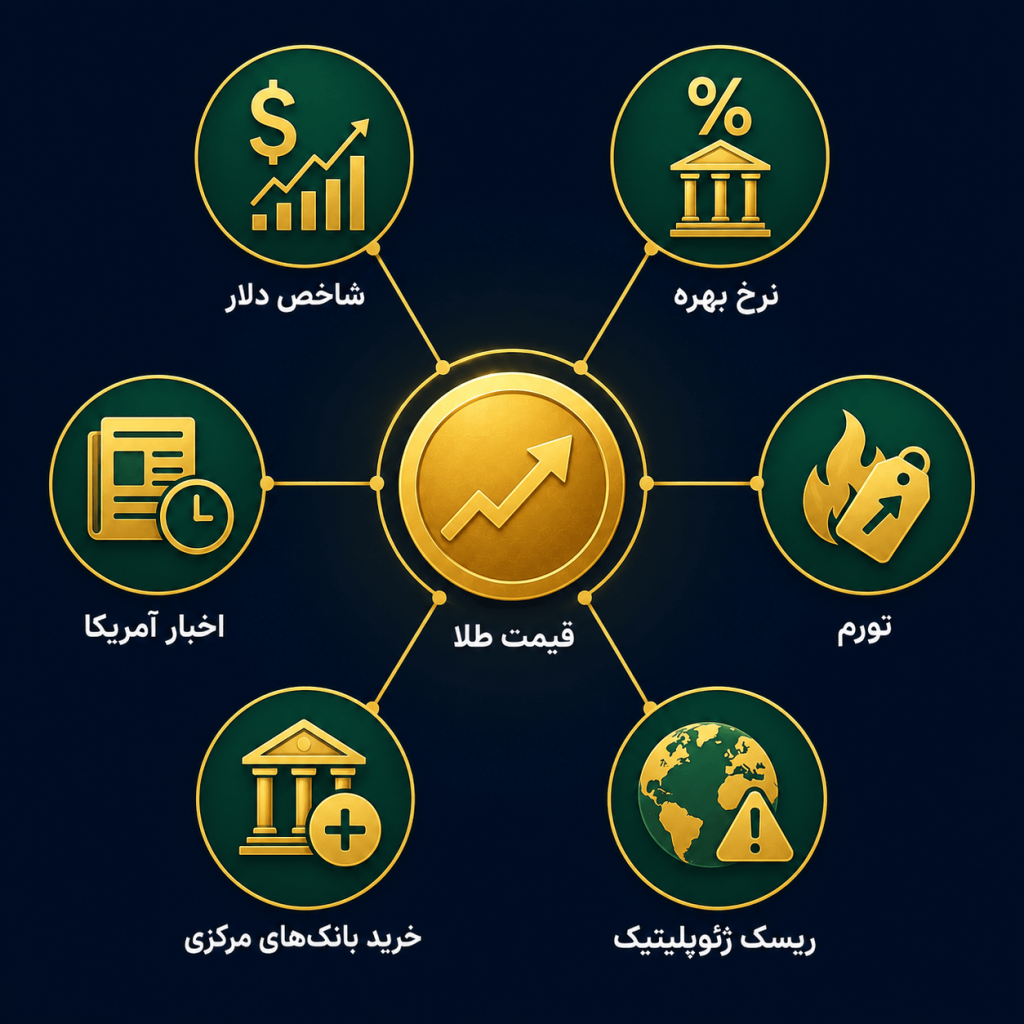
| Factor | Usual direction of effect | Explanation |
|---|---|---|
| Dollar index (DXY) | Inverse | A stronger dollar usually means cheaper gold, and vice versa. The first thing to check each day |
| Federal Reserve rates and bond yields | Inverse | Higher rates raise the opportunity cost of holding a non-yielding asset |
| Inflation and inflation expectations | Direct | Gold is the classic hedge against currency debasement |
| Geopolitical risk and crises | Direct | In periods of instability, capital moves towards a safe haven |
| Central bank buying | Direct | The large, sustained demand of recent years has been among the drivers of record prices |
| US employment and inflation data (NFP, CPI) | Immediate and violent | Gold's most volatile minutes. Always check the timing in an economic calendar |
The Best Hours to Trade Gold
- Morning through midday (Asian session): movement is generally quiet and range-bound. Good for analysis and planning the day, not for impulsive entries.
- From around 11:30 Tehran time (London open): the market comes alive. The day's first directional moves usually begin here.
- Roughly 16:30 to 20:30 Tehran time (London–New York overlap): gold's golden hours — highest volume, cleanest movement. For an Iranian trader whose evenings are free, that overlap is a gift.
- The minutes around US data releases: spreads widen, slippage increases, and price can jump tens of dollars in seconds. Beginners should watch, not trade.
Technical Analysis on Gold: Know the Instrument's Character
Every principle of technical analysis — trend, levels, candles — applies to gold, but this instrument has several distinctive habits:
- An affection for round numbers: hundred-dollar levels such as 4,000 and 4,100, and even fifty-dollar increments, act as magnets for orders. The significant reactions and breaks tend to happen precisely there.
- Stop hunts and false breaks: gold is notorious for making a rapid move in the opposite direction, collecting nearby stops, before the real move begins. The remedy: give your stop room behind the level, and wait for confirmation — a candle close — rather than jumping on the first break.
- Extended, rapid moves: when gold gets going, pullbacks are shallow. Trading with the trend matters doubly here, and hunting tops and bottoms costs more than anywhere else.
- Respect for higher timeframes: H4 and daily levels work remarkably cleanly on gold. Start your analysis there and reserve the lower timeframe for entry timing only.
A Sample Starting Strategy: Trend Pullback on Gold
- Direction: H4 is in an uptrend — higher highs and higher lows — and price is trading above the EMA 50.
- Location: wait for a pullback to a valid support level or a round number aligned with the EMA.
- Signal: on H1, at that same zone, a bullish confirmation candle forms — a pin bar or engulfing.
- Entry and stop: enter after the signal candle closes; place the stop below the candle's wick with a few extra dollars of room. Gold shows no mercy to tight stops.
- Take profit: the next resistance or round number, with a risk-to-reward ratio of at least 1:1.5.
- Position size: by formula only — risk amount ÷ (stop in dollars × 100). Example: $10 of risk with an $8 stop → 10 ÷ 800 ≈ 0.01 lots.
Run this setup on a demo account for at least a month and log every trade. Gold is not an instrument to practise on casually with live money.
Common Mistakes When Trading Gold
- Using a currency-pair stop on gold: a 30–40 pip stop that makes sense on EUR/USD gets taken out by ordinary noise in gold. Let gold's own volatility determine the stop.
- Using a currency-pair position size on gold: 0.1 lots on EUR/USD means $1 per pip; on gold it means $10 for every dollar of movement — ten times heavier than many beginners imagine.
- Trading through NFP and rate decisions: gold's most seductive and most lethal temptation. Wide spreads and slippage can turn even correct analysis into a loss.
- Averaging into losses: in an instrument with extended moves, “it got cheaper, I'll buy more” is the fastest route to a margin call.
- Conflating the ounce with the domestic market: analysis of the coin premium and the Tehran dollar rate has nothing to do with XAU/USD. Analyse the global ounce with DXY, interest rates and the economic calendar.
Global Ounce or Physical Gold? A Fair Comparison
| Feature | Global ounce (XAU/USD at a broker) | Physical gold and coins on the domestic market |
|---|---|---|
| Direction of profit | Two-way — rising and falling | Rising prices only |
| Capital needed to start | Low, with leverage and micro lots | At minimum the price of one piece or coin |
| Ownership | None — it is a CFD contract | A physical asset in your possession |
| Specific risks | Leverage, broker risk, swap and commission costs | Coin premium, storage and theft risk, authenticity |
| Effect of the domestic dollar rate | None | Direct and strong |
| Suitable horizon | Short and medium-term trading | Long-term saving and investment |
A fair summary: these two are not competitors. They are tools for two different purposes — physical gold for preserving a family's wealth over the long term, and the global ounce for active trading, with all the education and risk management that requires. Many Iranian traders hold both and use each for what it is good at.
Frequently Asked Questions
How much capital do you need to start trading gold?
Technically it is possible with a few dozen dollars at 0.01 lots, but given gold's volatility an account that allows room for wider stops — several hundred dollars, or a cent account — is more sensible. More important than the amount is observing the 1–2% risk ceiling on every trade.
What is the best timeframe for analysing gold?
Read the main structure on the daily and H4 charts, then refine your entry on H1 or M15. Analysing gold only on low timeframes means getting lost in noise and hunted by false moves.
Why is the spread on gold wider than on currency pairs?
Higher volatility and the different nature of the market increase the risk of making a market in this instrument, and brokers reflect that in the spread. When choosing a broker, compare gold spreads separately — one that is cheap on EUR/USD is not necessarily cheap on gold.
Is trading the gold ounce the same as buying gold online?
No. With XAU/USD you own no gold at all; you trade the change in the global price, and you can profit from declines. Domestic services offering online purchase of melted gold are a different product with the logic of physical investment.
Is gold a suitable first instrument for a beginner?
The lower-risk path is to learn the fundamentals on calmer pairs such as EUR/USD on a demo account, then come to gold with minimal position sizes. If you do start directly with gold, trade demo only for at least one to two months and apply the position-sizing formula from day one.
Conclusion
Gold is the most generous and simultaneously the most unforgiving instrument on the market for an Iranian trader: it offers large, clean movements, and it punishes indiscipline in sizing and stop placement faster than anything else. The formula for succeeding with it is the same four pieces as always — trend, level, confirmation, risk management — only with bigger numbers and more respect for volatility.
The practical step: open a demo account, pull up XAU/USD on H4, mark the round numbers and the current trend, and practise the pullback setup from this article for a month.