


- August 11, 2026
- Posted by: Reza Kazemi
- Category: Forex Education

The question you hear in every gathering of Iranian traders these days: prop firm or personal account? The advertising is seductive — “trade our capital, keep up to 90% of the profit” — and the reality, as usual, is more complicated than the advertising. Prop trading is neither a master key to wealth nor a scam. It is a specific partnership model with strict rules that works excellently for one particular group of traders, and for everyone else simply produces a series of burned challenge fees.
This guide explains it without inflation: what prop trading actually is, how challenges work, what the income model looks like, the reality of access for Iranian traders, and — most importantly — who should pursue prop trading and for whom it is still too early.
This article is the final link in the beginner’s learning path, and not by accident: prop trading is the final examination of every skill built along the way.
What Is Prop Trading?
The short answer: proprietary trading means trading a company’s capital rather than your own. A prop firm gives traders who prove their competence in an evaluation — the challenge — an account with substantial capital, usually between $5,000 and $200,000, and the resulting profit is split between the trader and the firm. The trader’s share at common firms is typically 70 to 90 per cent.
What about losses? On paper they belong to the firm — but in practice, exceeding the permitted loss means losing the account and starting again from scratch, with the cost of a new challenge out of your own pocket.
Understand the economics and the rest falls into place: the primary revenue of most online prop firms comes from challenge registration fees — and industry data shows the majority of participants fail. In other words, the prop business model is built on the evaluation being difficult. That is neither good nor bad in itself. It simply means you should enter with your eyes open and genuine skill, not on the enthusiasm of an advert.
How Does a Prop Challenge Work?
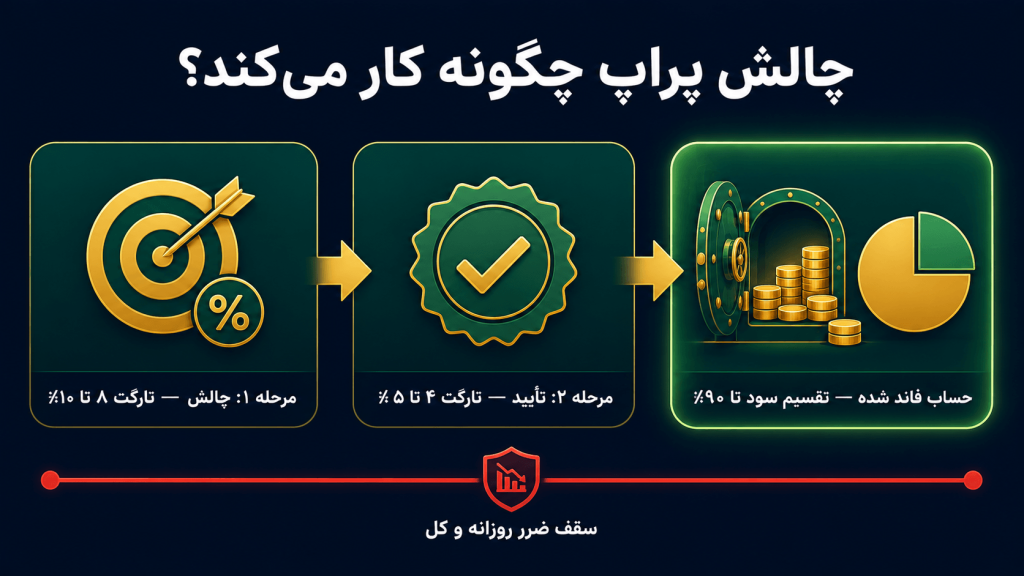
The common structure is a two-phase evaluation, though some firms offer one-phase or instant-funding versions. Exact figures vary between firms, but these are the typical industry ranges:
| Rule | Phase 1 (challenge) | Phase 2 (verification) | Funded account |
|---|---|---|---|
| Profit target | Usually 8–10% | Usually 4–5% | None — real profit is split |
| Maximum daily loss | Usually 4–5% — the most important and most lethal rule | ||
| Maximum total drawdown | Usually 8–12% | ||
| Time limit | At many firms today, unlimited or flexible | — | |
| Additional rules | Minimum trading days, restrictions on news trading, prohibition of certain styles such as copy trading and arbitrage | ||
Three things to check personally in each firm’s own rules before buying any challenge: how daily loss is calculated (on balance or on equity? — the difference is decisive), the type of total drawdown (static or trailing?), and the rules on trading around news. Most of the “unfair failures” traders describe turn out, on inspection, to be a failure to read exactly these details.
The Income Model: Real Numbers Instead of Dreams
Suppose you have passed the challenge on a $50,000 account and, on the funded account, generate a reasonable and sustainable 4 per cent a month — which is itself very strong performance. That is $2,000 of profit, and at an 80 per cent share, $1,600 a month. Serious income for an Iranian trader, without risking an equivalent amount of personal capital. That is the genuine appeal of prop trading: renting capital in exchange for proven skill.
Many firms also operate scaling programmes, where sustained performance raises the account ceiling in stages. But look at the other side too: one bad day that breaches the daily loss limit and all of it resets to zero. Prop trading is the game of “survive first, profit second” in its purest form.
Prop Trading for Iranians: The Reality of Access
As with brokers, sanctions have drawn lines here too: the large international prop firms — FTMO and its peers — do not serve clients resident in Iran. In their place, recent years have seen prop firms emerge that work specifically with the Iranian market, with Persian-language dashboards, Persian support, and rial and USDT payments. FeneFX is among the better known of these to Iranian traders, and other options are also active.
Because this sector is younger and less regulated than the brokerage industry, checking credibility carries even more weight. Before buying a challenge from any firm, verify these five points:
- Payment record: over what period, and with what regularity, have genuine trader withdrawal receipts been published — not the firm’s own promotional screenshots?
- Age and transparency: how many years has the firm operated? Is information about the company, the team and the rules clear and in writing?
- Written, unambiguous rules: any rule written vaguely will be interpreted against you at the moment of payment.
- Withdrawal route: methods (rial or USDT), minimum withdrawal, and the payout schedule — fortnightly or monthly, for instance.
- Cost against risk: treat the challenge fee as an education cost with a chance of return, and pay only an amount whose loss would not disrupt your finances.
Advantages and Disadvantages
| Advantages | Disadvantages |
|---|---|
| Access to substantial capital without risking personal savings | Challenge fees — for the majority who fail, a pure cost |
| A limited, defined maximum loss: only the challenge fee | Strict rules — one bad day loses the account |
| Enforced discipline: prop rules are professional risk management | Psychological pressure from targets and drawdown limits, heavier than on a personal account |
| Scalable dollar income through scaling programmes | Counterparty risk from the firm itself, particularly younger ones, and restrictions on trading styles |
Prop Firm or Personal Account? Who Should Choose Which
| Criterion | Personal account | Prop firm |
|---|---|---|
| Capital required | Your own real capital | Only the challenge fee |
| Freedom of action | Complete — any style, any level of risk | Limited by the firm’s rules |
| Profit share | 100% | Usually 70–90% |
| Psychological pressure | Losing your own money | Fear of losing the account, plus timed targets |
| Suited to | Learning, unrestricted styles, sufficient capital | A proven trader with positive statistics but little capital |
An honest answer to “when should I go for prop trading?”: when you have at least three to six months of recorded statistics that are profitable or break-even, with risk kept below 1 per cent. Prop trading is not a place to learn; it is a place to monetise skill you already built. Anyone who has not yet achieved consistency on a demo or personal account will only burn banknotes in a challenge — regardless of what the adverts say.
How to Prepare for a Challenge
- Simulate it fully before buying: trade for a month on a demo account with the exact balance and rules of that challenge — profit target, daily loss limit, total drawdown. If you cannot pass the demo version, you will not pass the paid one.
- Take smaller risk per trade than usual: with a 5% daily loss ceiling, a rational risk per trade is 0.5 to 1 per cent — meaning even several consecutive stop-outs will not take you to the edge.
- Forget the target, execute the process: the paradox of challenges is that staring at the profit target creates haste and overtrading, and brings failure closer. Take your own setups at small risk; the target either arrives, or arrives later in a challenge with no time limit.
- Write your psychological rules down in advance: stop after two losses in a day, step away after every stop-out, no revenge trading. That toolkit matters more here than anywhere else.
Common Mistakes in Prop Challenges
- Buying a challenge instead of an education: the most common and most expensive mistake. The challenge is the final exam, not the classroom.
- Oversized positions to “pass quickly”: at 3–4% risk per trade, two stop-outs put you at the daily ceiling and the game is over.
- Not reading the fine print: equity-based calculation of daily loss, trailing drawdown, prohibitions on holding positions over the weekend or through news. Ignorance is not an accepted excuse.
- Buying challenges back to back on impulse: failing and immediately purchasing the next challenge with the same method is revenge trading on a larger scale. Between two challenges, a post-mortem and a correction are obligatory.
- Trusting “no challenge” firms and outsized promises: the easier the entry and the bigger the promises, the greater the likelihood of trouble at payment time. Understand the firm’s revenue model before handing over money.
Frequently Asked Questions
Is prop trading possible for Iranians?
Yes. Although the large international prop firms do not accept clients resident in Iran because of sanctions, firms focused on the Iranian market — with Persian dashboards and rial and USDT payments — are active. Before buying a challenge, always check the firm’s payment record and the clarity of its rules.
How much does a prop challenge cost, and is the fee refunded?
The cost depends on account size — from a few dozen dollars for small accounts to several hundred for large ones. Many firms refund the challenge fee after you succeed, with the first profit split. Check this in the rules of the specific firm.
Are you really trading in the market with the prop firm’s money?
At most online firms your trading takes place in a simulated environment, and the firm pays you based on your performance; some firms hedge a portion of their best traders’ activity in the live market. For you as the trader the outcome is the same: adherence to the rules plus profit equals payment under the contract.
Which is the hardest rule in a challenge?
The daily loss limit. Unlike total drawdown, which allows room to recover, one bad day is enough to end everything. The counter-measures are small risk per trade — 0.5 to 1 per cent — and a rule to stop after two losses in a day.
Prop firm or personal account — which is better?
For a proven trader with limited capital, a prop firm is exceptional leverage. For someone who has not yet reached consistency, a demo account followed by a small personal account is the right path. Prop trading monetises skill; it does not create it.
Conclusion: Prop Trading Is the Final Exam
Prop trading is a genuine opportunity — for the right person at the right time. A trader with a tested strategy, the risk formula in their blood and their mind under control can turn skill into scalable dollar income through a prop firm. For everyone else, challenges are simply a more expensive way of discovering that they are not ready yet.
You know the recommended path from the start of this series, and prop trading is only its final station: demo account → strategy and journal → small live account → three months of positive statistics → and then, with a clear conscience, a prop challenge. If any link in that chain is weak, the answer is in the beginner’s guide.