


- August 11, 2026
- Posted by: Reza Kazemi
- Category: Forex Education
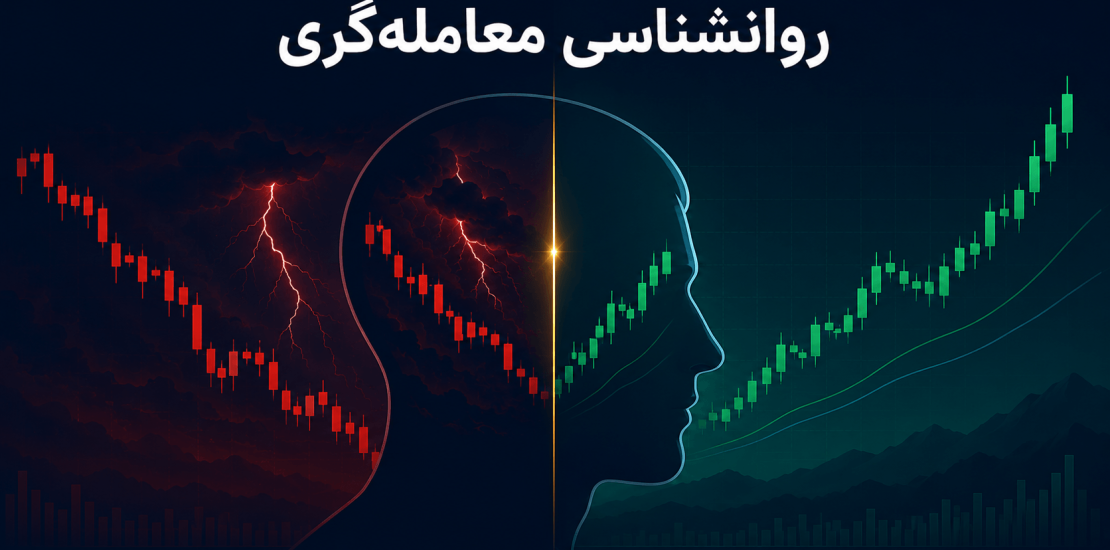
A thought experiment: show a trader who has just taken three consecutive losses the best setup in the world. In all likelihood they will either skip it out of fear, or enter at double size to “make it back”. The setup is the same setup. What changed is the trader's mind. This is precisely the territory of trading psychology — where knowledge of analysis ends and the real battle begins.
This article does not deal in generalities about “overcoming fear and greed”. We examine seven specific mental errors — the ones burning real accounts every day — with the symptoms and a practical antidote for each, and finish by assembling the toolkit for building discipline.
Why Psychology Is the Missing Link for Most Traders
The forex market has one merciless characteristic: between knowing and doing there is a gap the width of your emotions. Everyone knows you should not move a stop loss — and a large share of that same “everyone” moves it under pressure. The reason is not weakness of character. Our brains evolved for survival in nature, not for trading: we feel a loss more acutely than an equivalent gain, we seek validation from the crowd, and after every defeat we want immediate restitution. The market hunts exactly those instincts.
The good news: these errors are known, predictable and controllable — not through raw willpower, but through systems and rules. Let us go through them.
Seven Mental Errors
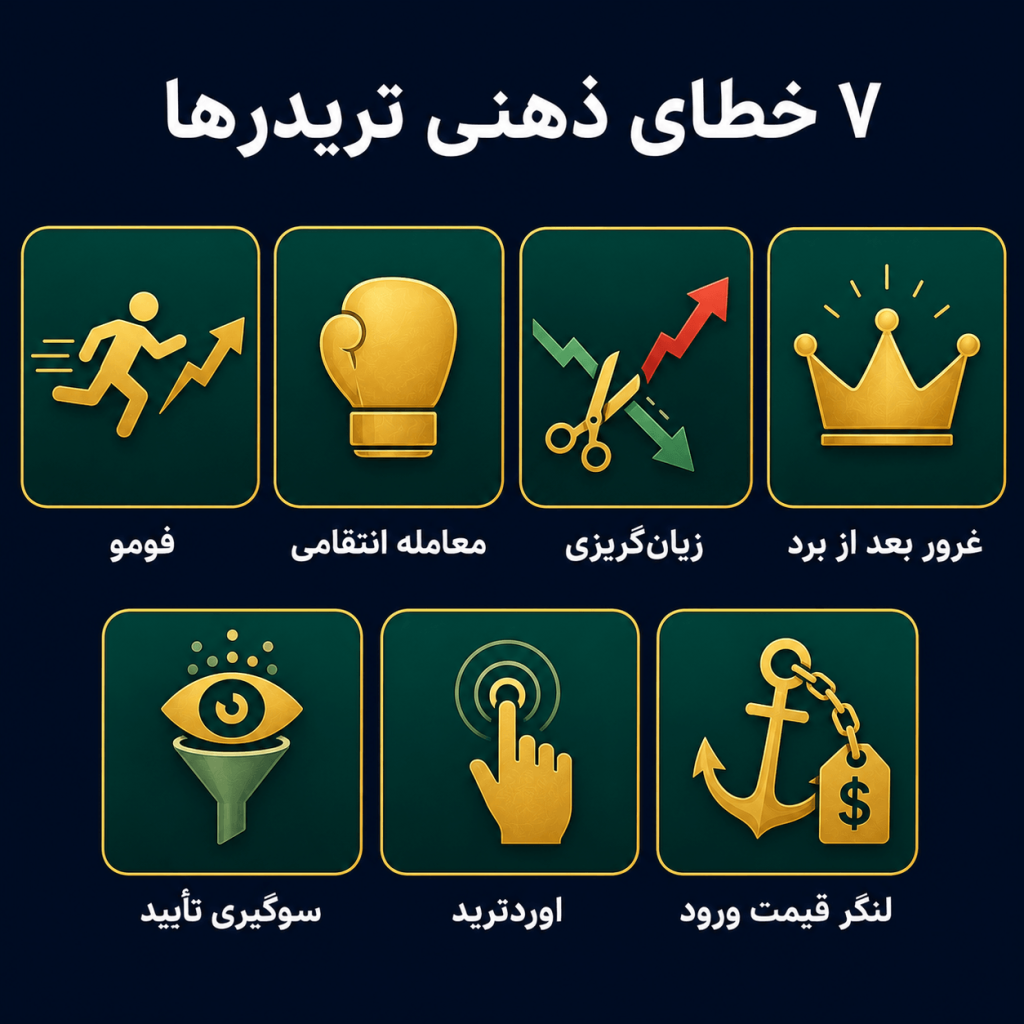
1. FOMO — Fear of Missing Out
The familiar scene: gold has taken off without you, and every green candle feels like a smirk aimed at your face. Mid-move, with no setup and no level, you jump in — and that is usually the exact moment the pullback begins.
Symptoms: entering without matching your plan, a sense of “now or never”, constantly checking an instrument you have no position in.
Antidote: frame this sentence: the market will be open tomorrow. Opportunity in forex is like a bus; the next one is always coming. The practical rule: if you missed the setup at the moment it formed, that move is over for you. Wait for the next setup, not for the continuation of the one you missed.
2. Revenge Trading — A Personal War With the Market
The familiar scene: you got stopped out and five minutes later you were back in the same instrument at double size, to “get your money back”. The market owes you nothing and does not know you exist; it simply swallows the larger position too.
Symptoms: entering shortly after a loss, size above what the plan allows, a raised pulse and anger as you click.
Antidote: a mechanical stop-after-loss rule. After every stop-out, put at least fifteen minutes of physical distance between you and the platform. After two consecutive losses, the next trade is at half size. After three, the trading day is over. Write these rules into your plan so that in the moment of anger, you are not the one deciding.
3. Loss Aversion — Small Wins, Large Losses
The familiar scene: a trade is 20 pips in profit and you close it on the first opposing candle, afraid the gain will evaporate. Meanwhile a trade 50 pips underwater gets “patience, it'll come back”. The result in your journal: winners cut short and losers cultivated — the exact inverse of the profitability formula.
Symptoms: the average profit on your winners is smaller than the average loss on your losers; you close targets early and grant your stops extensions.
Antidote: move the decisions to before entry. Stop loss and take profit are placed at the start, and the trade is closed by one or the other — not by emotion halfway through. If you do intervene, only according to a rule written in advance, such as moving the stop to breakeven after a defined move.
4. Overconfidence — The Most Dangerous Days Follow the Best Ones
The familiar scene: five winning trades in a row and you feel you have cracked the market's code. You triple your size, start seeing your plan's filters as “unnecessary strictness” — and the market collects its lesson in humility, with interest.
Symptoms: arbitrarily increasing size after wins, taking “almost good” setups, a sense of invincibility.
Antidote: size is determined by the formula, not by your mood. The risk percentage is fixed, after a win as after a loss. And a professional habit: after any notable winning streak, open your journal and check how many of those wins actually followed the plan. The answer is usually humbling.
5. Confirmation Bias — Seeing Only What You Want to See
The familiar scene: you are long, and from that moment every bullish take online looks “reasonable” while every bearish warning looks like “seller FOMO”. The chart is the same chart. Your mental filter changed.
Symptoms: searching for analysis that agrees with your open position, ignoring invalidating signals, attachment to one scenario.
Antidote: one obligatory question on your checklist before every entry: “what would invalidate this analysis?” — and the answer is where your stop loss goes. A more advanced exercise: for every trade, write two lines describing the opposite scenario. A mind that has considered both sides finds it harder to become attached to one.
6. Overtrading — Addiction to the Button
The familiar scene: a quiet day with no setups, but you feel you “should be doing something”. Ten small pointless trades, spread and commission paid on every one, and by evening you are tired and down without knowing why. Trading is the job of executing opportunities, not manufacturing them.
Symptoms: a daily trade count far above your plan, trading out of boredom, opening a chart “just to look” and closing it with a new position.
Antidote: write a daily trade limit into your plan — three, for instance. On a day with no setups, “zero trades” is a victory. Record it in your journal as exactly that. Professionals spend a great many days simply watching.
7. Anchoring to Your Entry Price — “When It Comes Back, I'll Close”
The familiar scene: a trade is losing and all your hope is tied to one number: your entry price. But the market has no idea where you entered; that number is sacred only to you. The result: holding an invalidated trade out of devotion to a figure that means nothing to the market.
Symptoms: making decisions based on distance from your entry rather than current chart structure, removing the stop “until it comes back”.
Antidote: the magic question: “if I had no position right now, what would I do with this chart?” If the answer is “nothing, or possibly the opposite direction”, there is no reason to hold the trade. Analysis belongs to the chart, not to your entry price.
The Discipline Toolkit: Systems Instead of Willpower
Willpower is a finite resource; at eight in the evening after a working day, there is very little of it left. Professionals rely on systems rather than resolve:
- A written trading plan: permitted setups, risk percentage, daily loss ceiling, maximum number of trades, rules for intervening in an open position — all on paper, not in your head. A rule that has not been written down does not exist in the heat of the moment.
- A pre-entry checklist: five fixed questions before every click. Which setup is this? Is it with the trend? Where is the structural stop? Does it meet the minimum R/R? Is there red news coming? A negative answer to any of them means no trade.
- A journal with an emotion column: alongside the numbers for each trade, write one sentence about your state of mind — “entered angry after the previous stop-out”. After thirty trades, the personal pattern of your errors becomes unmistakable. And an error you can see is halfway to being fixed.
- Risk small enough that you can sleep: if you cannot sleep with an open position, the problem is not psychology — your size is too large. Stress is a direct function of position size, and the best sedative is the position-sizing formula.
- Planned distance from the chart: staring at every tick brings both exhaustion and the temptation to interfere. Place the trade with stop and target, then leave. A four-hour chart needs looking at every four hours, not every four minutes.
Two Books Worth Your Time
The literature on trading psychology is full of repetitive books, but two classics by Mark Douglas — Trading in the Zone and The Disciplined Trader — remain the best starting point. Their central idea is the pillar of this article: thinking about trades in terms of probabilities rather than one at a time.
Once you accept that the outcome of any single trade is random and only the aggregate of a series matters, a large part of the emotional weight of each stop-out falls away by itself.
Frequently Asked Questions
Is psychology genuinely more important than analysis?
The two are not rivals: analysis is not executed without psychology, and psychology has nothing to execute without analysis. But market experience shows that most traders who fail had sufficient knowledge and lacked disciplined execution. So if you know your analysis and are still losing, the answer is probably in this article.
How do I tell whether my problem is psychology or strategy?
Open your journal and sort your trades into two groups: “followed the plan” and “outside the plan”. If the plan-following trades are profitable or break-even and the real damage comes from the others, the problem is psychological. If even your fully disciplined trades are losing, the strategy needs review. Without a journal, this diagnosis is impossible.
What should I do after a large loss?
Distance first: do not trade again until at least tomorrow. Then a post-mortem on paper — was the loss according to plan, the stop on a valid setup, or the result of a mental error? If it followed the plan, it is an ordinary cost of the profession and there is nothing to fix beyond continuing. If it was an error, add a rule to your plan that mechanically prevents the repeat. And return at half size while confidence rebuilds.
Is a demo account enough for practising psychology?
Demo is excellent for building analytical skill and habituating to process, but it does not simulate the emotions of real money. The correct path: build discipline on demo, then train the psychological muscle on a small live account — small enough that a loss is not painful, but real — and grow gradually.
Conclusion
The seven errors in this article — FOMO, revenge, loss aversion, overconfidence, confirmation bias, overtrading and entry anchoring — are not external enemies. They are our brain's default settings. Nobody eliminates them; professionals simply build a system that stops those feelings translating into clicks: a written plan, a checklist, a journal, small risk.
A successful trader is not someone without emotions. It is someone who gives their emotions no vote in the trade.
This week's exercise: write your five-question entry checklist, add an “emotion” column to your journal, and place ten trades on a demo account observing the checklist one hundred per cent. Whether they win or lose is beside the point — the discipline is the exercise.