


- August 11, 2026
- Posted by: Reza Kazemi
- Category: Forex Education
Every trader has seen this scene: flawless technical analysis, a clean setup, a correct entry — and then a colossal candle that swallows the stop loss in thirty seconds and keeps going. Behind that candle there has almost always been a news event: an interest rate decision, an employment figure, one sentence from the Federal Reserve chair. Fundamental analysis means understanding that force behind the curtain — the force that sets the market's overall direction, of which technical analysis only shows the footprints on the chart.
The good news is that using fundamentals does not require becoming an economist. This article covers exactly the part a trader genuinely needs: the logic of central banks and interest rates, the important economic indicators, reading an economic calendar properly, and — most importantly — three practical ways of combining this knowledge with technical analysis.
What Is Fundamental Analysis?
Fundamental analysis in forex means assessing the real strength of economies in order to anticipate the direction of their currencies. The underlying logic is simple: a currency is the stock of a country's economy. An economy that is growing, has inflation under control and offers an attractive interest rate draws global capital — and to enter, that capital must buy the country's currency. The result is a stronger currency. The reverse holds equally.
The difference from technical analysis is the horizon. Fundamentals answer “why” and “in which direction”, over weeks and months. Technicals answer “where” and “when”, over hours and days. The complete trader keeps both eyes open.
Central Banks and Interest Rates: The King of Fundamentals
If you were to take only one concept from all of fundamental analysis, it is this: money moves towards higher interest. When a central bank raises rates, holding that currency becomes more profitable, global capital flows towards it, and the currency strengthens. A rate cut produces the opposite. That is why central bank meetings — the US Federal Reserve above all — are the most important events on any month's calendar.
Two words you will see constantly in analysis:
- Hawkish: a restrictive tone; a leaning towards raising rates or holding them high to contain inflation → usually positive for the currency.
- Dovish: a soft tone; a leaning towards cutting rates to support growth and employment → usually negative for the currency.
A professional point: the market reacts less to the decision itself than to the path ahead. The Fed may raise rates while speaking dovishly about the future — and the dollar falls rather than rises. That is why the press conference after a meeting is sometimes more volatile than the rate announcement itself.
Economic Indicators You Need to Know
| Indicator | Release timing (US) | What it measures | Typical effect of a stronger-than-expected reading |
|---|---|---|---|
| NFP (non-farm payrolls) | First Friday of each month | New jobs created — the pulse of the US labour market | Dollar strengthens, pressure on gold |
| CPI (consumer inflation) | Monthly | The rate of price growth — the main input to rate decisions | Dollar strengthens, on expectations of tighter policy |
| Interest rate decision (FOMC) | Eight meetings a year | The cost of money — the market's most important event | Depends on the decision and the tone of the statement |
| GDP | Quarterly | Overall economic growth | Currency strengthens |
| PMI (purchasing managers' index) | Monthly | The health of manufacturing and services — above 50 means expansion | Currency strengthens |
| Unemployment rate and wage growth | With NFP | Labour market quality and wage-driven inflationary pressure | Interpreted together with NFP |
| Retail sales | Monthly | Consumer spending power | Currency strengthens |
Bear in mind that this table gives the typical effect. In the real market, the reaction depends on how far the figure lands from expectations — which is the subject of the next section.
The Economic Calendar: The Number One Tool in This Article
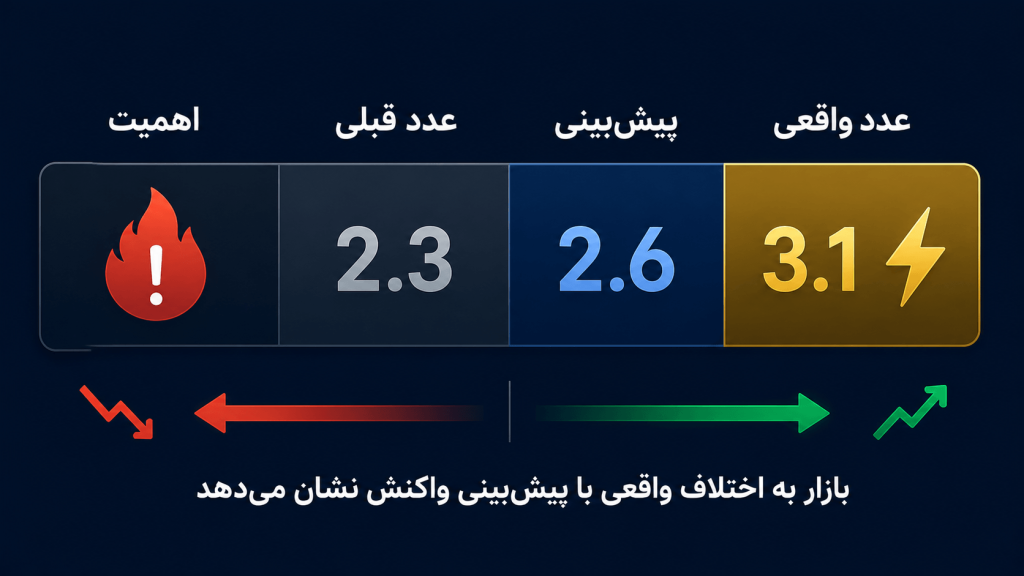
An economic calendar is the release schedule for every data point and event. It is free, available on sites such as Forex Factory, and MetaTrader 5 has one built in. Each row has four key columns:
- Impact: usually colour-coded red, orange or yellow. The red events are the ones that shake the market — those are the only ones you need to focus on.
- Previous: the indicator's reading last period.
- Forecast: the average analyst expectation — the most important column in the table.
- Actual: filled in at the moment of release.
The golden rule of reading a calendar: the market does not react to the figure itself. It reacts to the gap between the actual figure and the forecast. If NFP prints 200,000 when 205,000 was expected, nothing much happens — the market had already priced in roughly that. But 300,000 against an expected 200,000 is a genuine surprise, and the move is explosive. This is what “priced in” means, and failing to grasp it is the source of every beginner's recurring question: “the news was good, so why did the dollar fall?”
A weekly habit to start today: spend ten minutes on Sunday reviewing the week's calendar, note the red events in your own diary with the times converted to your local time zone — watching for daylight saving shifts — and build the week's trading plan around those moments.
Market Sentiment: Risk-On Days and Flight-to-Safety Days
The third layer of fundamentals is the global market's overall mood, described with two terms:
- Risk-on: the market is optimistic and money moves towards riskier assets — equities, commodity currencies such as the Australian dollar.
- Risk-off: fear dominates, whether from crisis, conflict or poor data, and money flees to safe havens: gold, the Japanese yen and the Swiss franc.
For an Iranian trader working mainly in gold, this concept is vital: a large share of gold's big moves comes not from economic data but from waves of geopolitical risk-off.
Three Practical Ways to Use Fundamentals as a Technical Trader
Now the applied part. You are not going to become an economist. You are going to use fundamentals in one of three roles:
- Role 1 — filter (mandatory for everyone). The simplest and most important use: do not open new positions in the minutes before and after red events, and if you hold an open position, either close it or make certain it has a stop loss and that you have accepted the risk. That single rule keeps you out of the club of traders taken out by an NFP candle.
- Role 2 — compass (recommended). Use fundamentals to set your bias: when the Fed is on a hawkish path, give priority in dollar pairs to setups aligned with a stronger dollar, and treat setups against it with more caution — or skip them entirely. Technicals are the trigger; fundamentals are the compass.
- Role 3 — news trading (professionals only). Trading directly on a release comes with wide spreads, severe slippage and deceptive two-way movement, and requires experience, infrastructure and a dedicated plan. For your first year of trading, set this aside completely — not doing it is itself a form of profit.
A Worked Example: An NFP Day Through a Disciplined Trader's Eyes
- Sunday: reviewing the week's calendar, you see NFP is released on Friday. You note the time in your own zone — 12:30 UTC, which is afternoon in Tehran.
- Friday, one hour before: you take no new positions. A trade in profit is either closed or has its stop moved to breakeven, taking risk to zero.
- At the release: you watch, nothing more. The actual figure is compared with the forecast, and the market moves violently — often in both directions — during the first few minutes.
- Thirty to sixty minutes later: once the dust settles, the market picks the direction it has digested. Now you look for an entry in that direction using your usual technical setups — trend, level, confirmation.
Does that behaviour sound tedious? Precisely. Profitable trading is far more disciplined than it is exciting.
Common Mistakes in Fundamental Analysis
- Trading “good news equals buy”: without comparing against the forecast and without understanding priced-in expectations, good news can be exactly the moment of the fall.
- Holding a position through news without a stop loss: the most common way a healthy account is destroyed in five minutes.
- Drowning in news: following ten news channels and parsing every official's sentence produces nothing but anxiety. The calendar's red events plus the Fed's rate path cover 90 per cent of what you need.
- Applying domestic economics to forex: inflation and the dollar rate in the Tehran market is not EUR/USD analysis. A pair's fundamentals are the economies of the two countries in that pair.
- Forgetting the time difference: an event at 8:30 in New York is afternoon in Tehran. One miscalculation is enough to be caught out mid-NFP.
Frequently Asked Questions
Can you trade without fundamental analysis?
You can trade purely technically, but not without the bare minimum of fundamentals — namely checking the economic calendar. A trader who does not know when the red events fall will sooner or later be a casualty of a news candle. The “filter” role is mandatory for everyone.
Which economic release matters most in forex?
Federal Reserve interest rate decisions, and the data that feeds directly into them: US inflation (CPI) and employment (NFP). Because the dollar sits on one side of most trades worldwide, those three events move the entire market, from currency pairs to gold.
What is the best economic calendar site?
Forex Factory is the best known among traders, and MetaTrader 5's built-in calendar is sufficient to start with. More important than which site you choose is the habit of reviewing it weekly and converting event times to your own zone.
Why does price sometimes move the opposite way on good news?
Two common reasons: either the news was already reflected in the price — “buy the rumour, sell the fact” — or the internal detail of the data, such as wage growth within an employment report, told a different story from the headline.
Does fundamental analysis apply to gold as well?
Very much so. Gold is arguably more fundamentally driven than many currency pairs, reacting sharply to US real interest rates, the dollar index and waves of geopolitical risk-off.
Conclusion
Fundamental analysis for a retail trader comes down to three sentences: money moves towards higher interest; the market reacts to the gap between reality and expectation; and during red-event minutes, standing outside the arena is safer. Those three principles, plus the habit of a weekly calendar review, put you ahead of most traders who only ever look at charts.
This week's exercise: open an economic calendar, note the week's red events in your own time zone, and practise on a demo account simply not trading during those windows. Discipline, like analysis, requires practice.