


- August 3, 2026
- Posted by: Reza Kazemi
- Category: Forex Education
If you have only just heard the word “forex” and have no idea where to begin, this guide was written for you. We will walk the learning path step by step: from the most basic concepts such as currency pairs and pips, through choosing a broker that actually accepts Iranian clients, working with MetaTrader, technical and fundamental analysis, risk management, and finally opening your first live trade.
Let us be straight from the outset: forex is neither a route to overnight wealth nor an outright scam. It is a profession, and like any profession it demands study, practice and patience. The data is consistent — a large share of new traders lose money in their first months, and the reason is almost always the same: entering the market without sufficient knowledge and without money management. This article is here to give you that foundation, without unrealistic promises.
Our suggestion: bookmark this page and work through it section by section, like a course. To practise as you go, open a free demo account right now and test what you learn on live charts without risking a penny.
What Is Forex? The World's Largest Financial Market
Forex is short for Foreign Exchange — a decentralised, global market where the currencies of different countries are bought and sold against one another. When you buy dollars or lira before a trip, you are performing the simplest possible currency trade. A forex trader does the same thing with the aim of profiting from price movement: buying the currency expected to strengthen and selling the one expected to weaken.
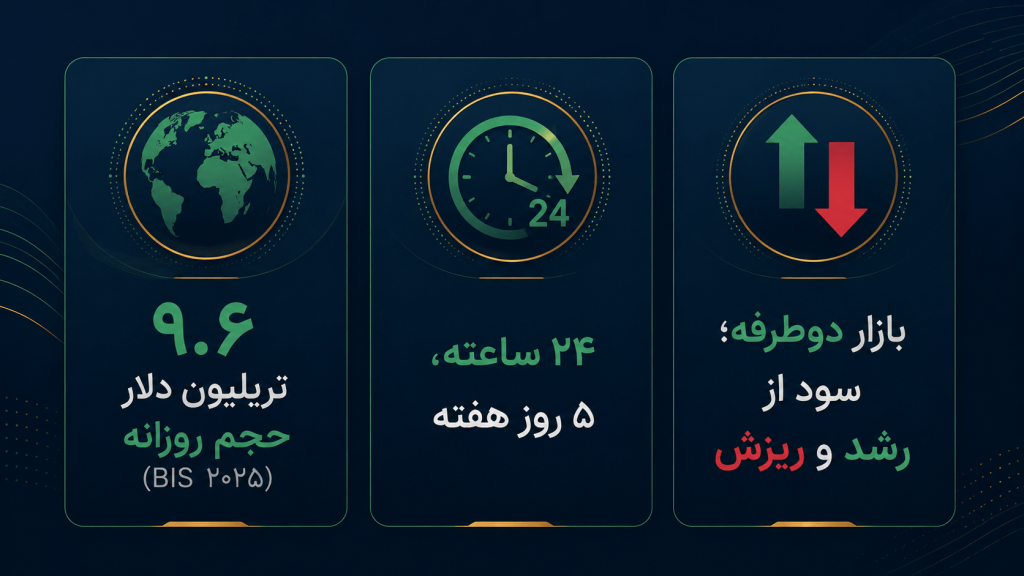
To grasp the scale, consider this: according to the latest triennial survey by the Bank for International Settlements (BIS), daily turnover in the foreign exchange market reached roughly $9.6 trillion in April 2025. That makes forex, by a wide margin, the largest and most liquid financial market in the world. For comparison, the entire daily turnover of the Tehran Stock Exchange does not reach even one thousandth of that figure.
Key Characteristics of the Forex Market
- Open 24 hours, five days a week: the market runs without interruption from Monday morning in Sydney to Friday evening in New York. In practice you can trade at almost any hour of the day or night, weekends excepted.
- Very high liquidity: in the major pairs, orders fill in fractions of a second. There is effectively no such thing as the buy and sell queues familiar from the Tehran exchange.
- A two-way market: you can profit from rising prices (a Buy trade) and from falling prices (a Sell trade) alike.
- Leverage: brokers let you trade positions many times larger than your actual capital — a tool that multiplies both profit and loss, and one we will come back to in detail.
- Low starting capital: unlike property or even a car, you can begin trading with a few dozen dollars — though preferably only after a spell on demo.
What Can You Trade in Forex?
Although the market is named after currency exchange, modern brokers offer a range of other instruments alongside currency pairs, in the form of CFDs (contracts for difference):
| Asset class | Popular examples | In brief |
|---|---|---|
| Currency pairs | EUR/USD, GBP/USD, USD/JPY | The core instrument — highest liquidity, tightest spreads |
| Precious metals | Gold (XAU/USD), silver (XAG/USD) | The favourite among Iranian traders thanks to its volatility |
| Stock indices | NASDAQ, S&P 500, DAX | Trading a country's equity market as a whole |
| Commodities | Brent crude, WTI crude, natural gas | Driven by global supply and demand news |
| Cryptocurrencies (CFD) | Bitcoin, Ethereum | Trading crypto price without owning the coin |
How Does the Forex Market Actually Work?
Currency Pairs: The Basic Unit of Trade
No currency is traded on its own in forex; a currency's value is always measured against another. That is why prices are quoted as pairs. In EUR/USD, for example, the euro is the “base currency” and the dollar the “quote currency”. If the pair is priced at 1.0850, one euro is worth 1.0850 dollars.
When you “buy” EUR/USD you are predicting that the euro will strengthen against the dollar; when you “sell”, you expect the dollar to strengthen. Pairs fall into three groups:
| Group | Examples | Characteristics |
|---|---|---|
| Majors | EUR/USD, GBP/USD, USD/JPY, USD/CHF, AUD/USD, USD/CAD, NZD/USD | Always include the dollar on one side — tightest spreads, highest volume |
| Minors / crosses | EUR/GBP, GBP/JPY, EUR/JPY | No dollar involved — slightly wider spreads, attractive moves |
| Exotics | USD/TRY, USD/ZAR | Emerging-market currencies — wide spreads, thin liquidity. Not recommended for beginners |
Trading Sessions
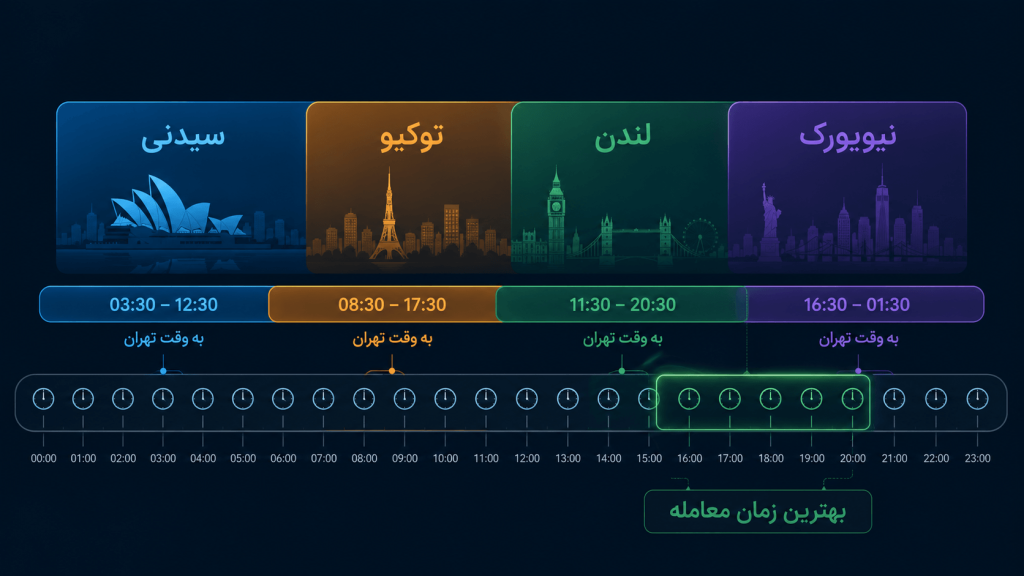
The forex market is open around the clock, but not all hours are the same. Trading runs through four main sessions, and the greatest volatility and liquidity typically occur when the London and New York sessions overlap — a window that happens to suit Iranian traders very well:
| Session | Tehran time* | UTC | What it means for you |
|---|---|---|---|
| Sydney | ≈ 01:30 – 10:30 | 22:00 – 07:00 | Thin volume — suits AUD and NZD pairs |
| Tokyo (Asia) | ≈ 03:30 – 12:30 | 00:00 – 09:00 | Moderate movement — most action on yen pairs |
| London (Europe) | ≈ 11:30 – 20:30 | 08:00 – 17:00 | The heaviest session — the day's main moves begin here |
| New York (US) | ≈ 16:30 – 01:30 | 13:00 – 22:00 | Major US economic releases — high volatility |
* Times shift by roughly an hour with daylight saving changes. Always check the exact time in your trading platform or an economic calendar.
Practical note: the London–New York overlap — roughly 16:30 to 20:30 Tehran time — is the busiest and most volatile window of the trading day. If you trade in the evening after work, you are sitting right in the middle of the best hours the market has to offer.
Forex Terminology You Need to Know Cold
Before any analysis, you need the language of the market. Take this table seriously — every one of these terms will come up repeatedly:
| Term | What it means |
|---|---|
| Pip | The smallest standard unit of price change. In most pairs it is the fourth decimal place — EUR/USD moving from 1.0850 to 1.0860 is 10 pips |
| Lot | The unit of trade size. One standard lot equals 100,000 units of the base currency. Mini lots (0.1) and micro lots (0.01) exist for smaller accounts |
| Spread | The difference between the buy (Ask) and sell (Bid) price — in practice, the main cost of every trade, and it goes to the broker |
| Leverage | The multiplier the broker extends to your capital. At 1:100 leverage, $100 lets you open a $10,000 position |
| Margin | The portion of your balance held as collateral while a trade is open |
| Margin call | The broker's warning when losses on open trades push your balance into dangerous territory. If you do nothing, positions close automatically — the stop-out |
| Stop loss (SL) | An order that closes a trade at a set price to cap the loss. The single most important survival tool in forex |
| Take profit (TP) | An order that closes a trade automatically at your target price |
| Swap | Overnight interest charged or paid for holding a position past the end of the trading day. Removed entirely on Islamic accounts |
| Drawdown | The decline in equity from its peak — the primary measure of a strategy's risk |
| Slippage | The gap between the price you requested and the price your order actually filled at, usually during volatile moments such as news releases |
A Simple Worked Example: How Profit and Loss Are Calculated
Suppose you buy EUR/USD at 1.0850 with a volume of 0.1 lots (a mini lot). At that size, each pip is worth roughly $1:
- If price reaches 1.0900 — a 50-pip gain — your profit is around $50.
- If price falls to 1.0820 — a 30-pip loss — you are down roughly $30.
Now the role of leverage becomes clear. To open that same trade at 1:100 leverage you need only about $108 in margin, yet profit and loss are calculated on the full position value of $10,850. This is exactly why leverage is a double-edged sword: without a stop loss and disciplined position sizing, the same attractive tool can wipe out an account in a handful of trades. If you want these three concepts to become second nature, read Pips, Lots and Leverage Explained with further worked examples.
Can Iranians Trade Forex? The Honest Picture
This is the first question on every Iranian trader's mind, so let us answer it plainly. Inside Iran, no official body licenses forex brokers, and domestic brokerages do not offer forex services. In practice, however, a substantial number of Iranians trade through international brokers that accept Iranian clients. A few points you should understand before starting:
- Sanctions and broker choice: many large brokers regulated in the US, UK or EU will not serve Iranian residents because of sanctions. Brokers that do accept Iranian clients generally hold offshore regulation — which is precisely why checking a broker's track record, age and reputation matters several times more for us than it does elsewhere in the world.
- Deposits and withdrawals: the most common routes for Iranians are rial transfers through the broker's partner exchanges, and Tether (USDT) or other cryptocurrencies. Step-by-step instructions for both paths, along with hidden costs and security considerations, are covered in our deposit and withdrawal guide.
- Identity verification: reputable brokers require identity documents before releasing withdrawals. A broker that asks for no verification at all is more convenient — and correspondingly riskier.
- Fraud risk: the Iranian forex scene is crowded with signal-selling channels, “guaranteed profit” promises and so-called investment funds. Keep one rule permanently in mind: there is no guaranteed profit in financial markets. Anyone making such a promise either does not understand the market or intends to deceive you.
To summarise: yes, forex trading is accessible to Iranians. But responsibility for choosing a credible broker, managing the risks around moving funds, and complying with local law rests entirely with you. For a detailed comparison of the options, see Best Forex Brokers for Iranians.
The Learning Roadmap: 10 Steps From Zero to Your First Trade
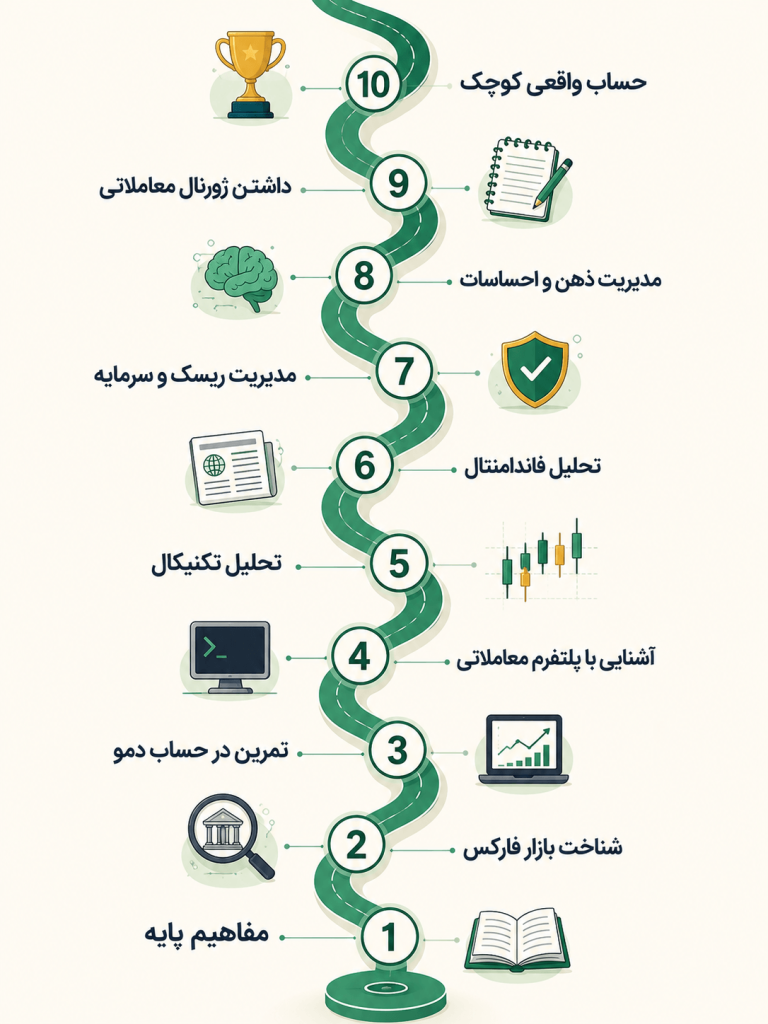
This section is the heart of the guide. Work through these ten steps patiently and in order, and you will already be ahead of ninety per cent of new entrants.
Step 1: Learn the Basics Properly, Not Superficially
Everything covered so far — pairs, pips, lots, leverage, spread — needs to be as automatic as multiplication tables. This is where the trader parts company with the gambler: a trader knows exactly what happens when they press Buy, how much they are risking, and what they lose in the worst case.
Step 2: Choose a Credible Broker
Broker selection is the most important non-trading decision you will make, because the world's best strategy is worthless at a broker that will not pay you out. What an Iranian trader should examine:
| Criterion | What to check |
|---|---|
| Reputation and history | Year founded, regulators, record of paying Iranian clients, genuine trader reviews |
| Acceptance of Iranian clients | Ability to register with Iranian documents and pass verification without friction |
| Deposits and withdrawals | Rial and USDT support, withdrawal speed, fees |
| Trading costs | Spreads on majors and gold, commission, swap, availability of an Islamic account |
| Trading platform | MetaTrader 4 and 5 support, execution quality, slippage |
| Persian-language support | 24-hour support in Persian, Persian website, in-house educational material |
| Account types | Cent or micro accounts for starting small, sensible minimum deposit |
Step 3: Open a Demo Account and Practise Without Risk
A demo account is a practice account funded with virtual money that runs on live market prices. This is where you learn the platform, opening and closing trades, placing stop losses and testing a strategy — without losing a single rial. Our advice is to trade on demo for at least one or two months, and not to touch real money until you have achieved consistency there. Rules for using a demo account professionally, and clear criteria for when to make the move to live, are set out in What Is a Forex Demo Account.
Step 4: Get Comfortable With MetaTrader 4 or 5
MetaTrader is the industry-standard trading platform in forex, and virtually every broker supports it. Version 4 (MT4) has been the traders' favourite for years; version 5 (MT5) offers a more modern feature set:
| Feature | MetaTrader 4 | MetaTrader 5 |
|---|---|---|
| Speed and execution engine | Light, low resource use | Faster, multi-threaded |
| Timeframes | 9 | 21 |
| Built-in economic calendar | No | Yes |
| Depth of market (DOM) | No | Yes |
| Default indicators | 30 | 38, plus additional analysis tools |
| Best suited to | Beginners and legacy expert advisors | Traders following several markets at once |
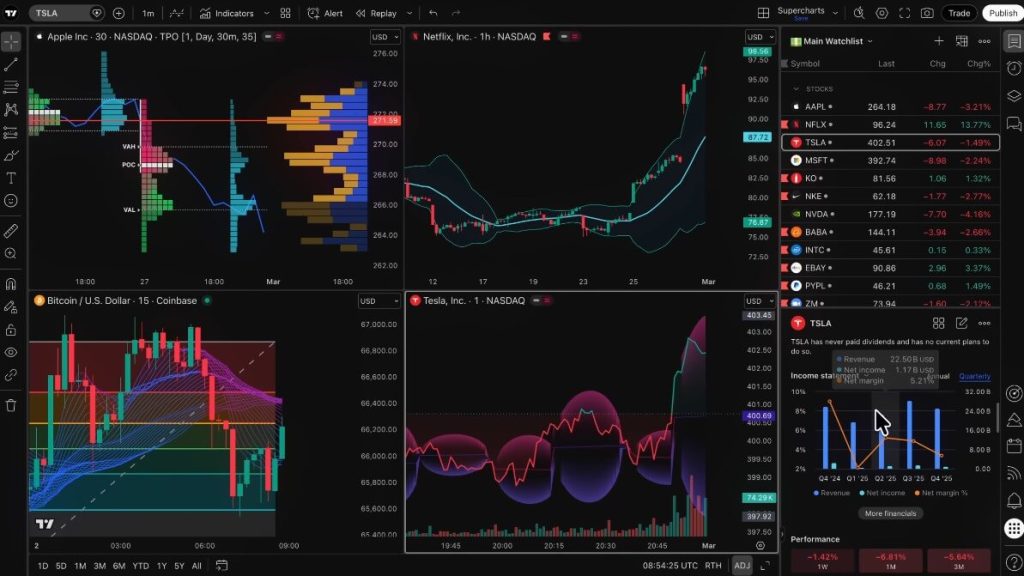
Alongside MetaTrader, TradingView is the best tool available for chart analysis. Most experienced traders analyse in TradingView and execute in MetaTrader. A visual walkthrough of both platforms is available in our MetaTrader tutorial.
Step 5: Learn Technical Analysis
Technical analysis means anticipating future price behaviour by studying how price has behaved in the past. It is the core skill of any trader, and we cover it in detail in the next section.
Step 6: Understand Fundamental Analysis and the Economic Calendar
Even if your style is purely technical, not knowing when major releases such as a Federal Reserve rate decision or US non-farm payrolls are due can put your account at serious risk — in those moments the market can move dozens of pips within seconds.
Step 7: Take Risk Management More Seriously Than Anything Else
If you retain only one section of this entire article, make it this one. Traders who last for years in the market are not necessarily the best analysts — they are the best risk managers.
Step 8: Understand Trading Psychology
Fear, greed and revenge trading are the three main killers of trading accounts. Knowing analysis without controlling your emotions is like owning a powerful car with no brakes.
Step 9: Build a Personal Strategy and Keep a Trading Journal
A strategy is a written set of rules for entry, exit, position size and trade management. Record every trade in a journal — even a simple spreadsheet will do: reason for entry, stop loss, outcome, mistakes. After fifty demo trades, that journal becomes your best teacher.
Step 10: Go Live With a Small Amount
Once you are consistent on demo, start with an amount whose loss would not change your life — a cent account, or a standard account with a few dozen dollars. The goal of your first months live is not to make money; it is to get used to how real money feels. And if you later build a stable track record but lack personal capital, prop trading offers a route to trading with a firm's funds.
Technical Analysis: Learning to Read Charts
Candlesticks: The Alphabet of the Chart
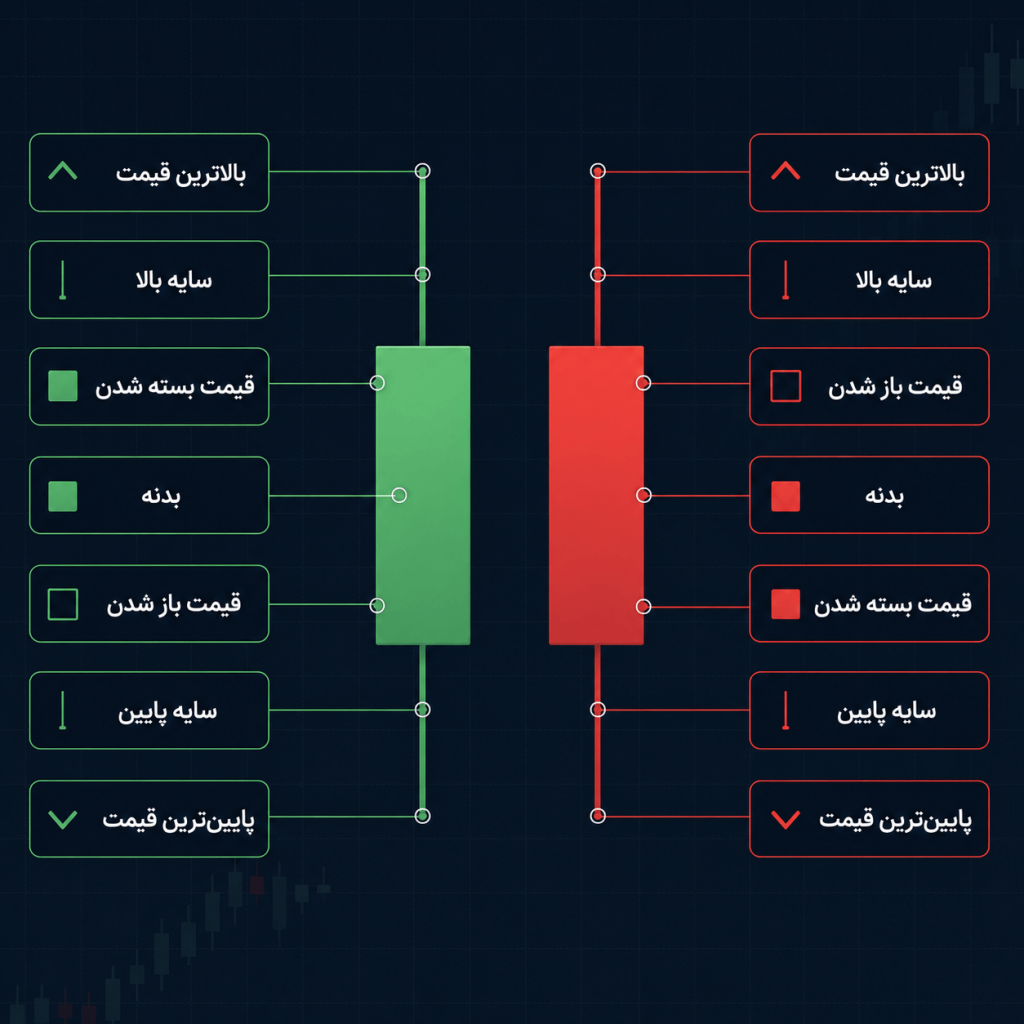
The Japanese candlestick chart is the most widely used way of displaying price. Each candle carries four pieces of data: the open, the close, the high and the low within a given period. Bullish candles are usually shown green, bearish ones red. Candlestick patterns such as the pin bar, engulfing and doji offer clues about shifting strength between buyers and sellers.
Support, Resistance and Trendlines
Support is a level where price has repeatedly reacted and bounced during declines; resistance is the opposite — a ceiling where advances have stalled. Adding trendlines to those levels is the simplest and, at the same time, most practical toolkit in technical analysis. Remember the market's best-known rule: “the trend is your friend” — trading in the direction of the trend measurably improves your odds.
Popular Indicators and What They Are For
| Indicator | Type | Primary use |
|---|---|---|
| Moving average (MA / EMA) | Trend | Identifying trend direction and dynamic support/resistance |
| RSI | Oscillator | Spotting overbought and oversold conditions, and divergences |
| MACD | Trend / momentum | Detecting momentum shifts and signal crossovers |
| Bollinger Bands | Volatility | Measuring volatility and identifying price compression |
| Fibonacci retracement | Drawing tool | Locating likely levels where a pullback ends |
An important warning: more indicators does not mean better analysis. A chart cluttered with ten indicators only paralyses decision-making. Learn one or two tools deeply instead.
Price Action and Modern Styles
Price action means analysing pure price behaviour without relying on indicators — an approach that has gained a large following among Iranian traders in recent years. Styles such as Smart Money and ICT are branches of the same thinking, focused on the footprints left by bank and institutional liquidity. Our advice: learn classical technical analysis first, then move on to advanced styles. The full course is in Technical Analysis From Scratch.
Fundamental Analysis: When News Moves the Market
Fundamental analysis examines the economic, monetary and political factors that drive currency values. Over the long run a currency's price reflects the health of its economy, and central banks — through interest rate decisions — are the single biggest driver of the currency market. The key events every trader should watch in the economic calendar:
| Event / indicator | Source | Market impact |
|---|---|---|
| Interest rate decision | Federal Reserve, ECB and others | The strongest driver — a rate rise typically strengthens the currency |
| Non-farm payrolls (NFP) | US — first Friday of each month | Violent multi-pip moves in the dollar and gold within minutes |
| Inflation (CPI) | Each country | Sets expectations for the future path of rates |
| Gross domestic product (GDP) | Each country | The broad picture of economic growth |
| Purchasing managers' index (PMI) | Each country | An early signal of expansion or contraction |
| Central bank speeches | — | A single sentence can reverse market direction |
The golden rule for beginners: do not trade in the minutes immediately before and after major news, and never hold an open position through a release without a stop loss. Exact release times are available in economic calendars such as Forex Factory. How to read the calendar properly, what “priced in” means, and three practical ways to use news are covered in our fundamental analysis guide.
Risk Management: The Most Important Lesson in Forex
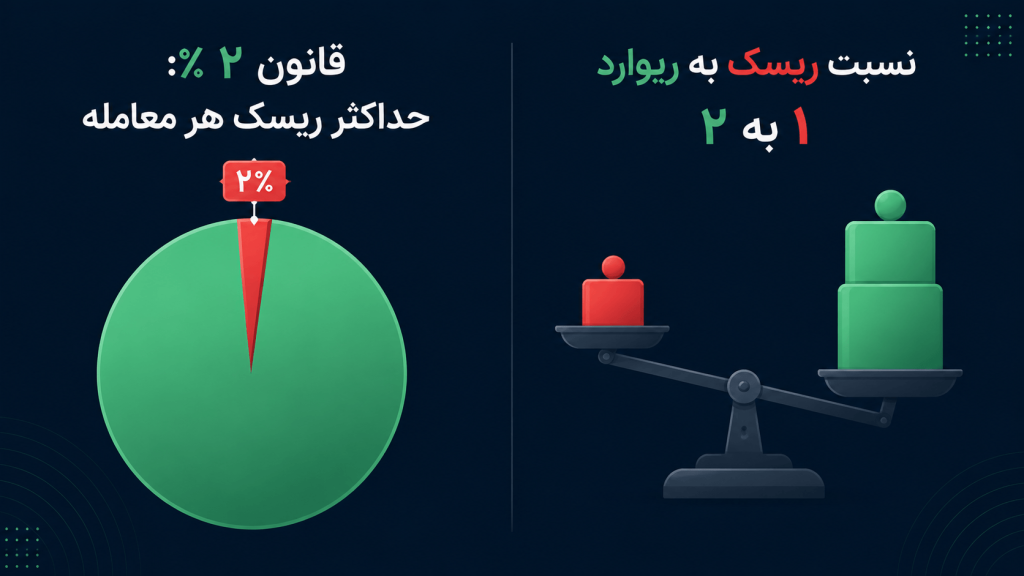
An uncomfortable but liberating fact: no strategy has a 100% win rate, and losses are an inseparable part of trading. The job of risk management is to keep those losses small and recoverable. Three essential principles:
- The 1–2% rule: risk no more than 1 to 2 per cent of your total capital on any single trade. Follow it and even ten consecutive losses will not remove you from the market.
- A stop loss, without exception: never open a trade without one. Moving a stop loss in the hope that price will come back is the most common way accounts are destroyed.
- Risk-to-reward ratio (R/R): only take trades where the potential gain is at least 1.5 to 2 times the potential loss.
The power of risk-to-reward is visible in this table — with a decent ratio you can be profitable even with a win rate below 50%:
| Risk-to-reward ratio | Minimum win rate to break even |
|---|---|
| 1 : 1 | 50% |
| 1 : 1.5 | 40% |
| 1 : 2 | 34% |
| 1 : 3 | 25% |
A practical example: your capital is $1,000, so under the 2% rule your maximum risk per trade is $20. If your stop loss is 20 pips away, your permitted position size is 0.1 lots (each pip ≈ $1). Just like that, risk determines position size — not excitement. The formulas and position-size calculators are explained in full in Risk and Money Management in Forex.
Trading Psychology: The Real Battle Is Inside Your Head
Most losing traders can analyse perfectly well. What they cannot do is manage themselves. The three main enemies of a trader's mind:
- Greed: increasing size after a run of wins, removing take profits in the hope of more, overtrading.
- Fear: closing winning trades too early, skipping valid setups after a couple of losses.
- Revenge trading: jumping back in immediately after a loss with a bigger position to “win it back” — the fastest known route to a margin call.
The remedy is a written trading plan and mechanical adherence to it: know before you enter where you get in, where you get out and how much you are risking — then do not let the emotion of the moment rewrite those decisions. Mark Douglas's classic Trading in the Zone is the best starting point on this subject. The seven most common mental errors traders make, and a practical antidote for each, are covered in our trading psychology guide.
10 Common Beginner Mistakes
- Going straight to real money without a demo period
- Trading without a stop loss, or constantly moving it
- Using excessive leverage with unreasonable position sizes
- Risking money needed for everyday life
- Blindly following Telegram signals instead of learning to analyse
- Overtrading — opening dozens of positions a day with no valid reason
- Changing strategy after every losing trade
- Trading through major news releases without sufficient experience
- Keeping no trading journal, and repeating the same mistakes
- Believing “guaranteed monthly return” promises and handing capital to strangers
Demo Account or Live Account? A Full Comparison
| Feature | Demo account | Live account |
|---|---|---|
| Capital | Virtual, no risk | Your real money |
| Prices and charts | Real and live | Real and live |
| Psychological pressure | Effectively zero | Real — the single biggest difference |
| Purpose | Learning the platform, testing strategies | Earning, and genuine market experience |
| Suited to | All beginners, and testing any new strategy | Traders who have achieved consistency on demo |
The correct sequence is: demo first, then a small live account, then a gradual increase in capital. If you are ready to start practising, open your free demo account in under a minute and apply everything in this article directly on the chart.
The Costs of Trading Forex
Your net profit is gross profit minus costs, so it pays to know them:
- Spread: the primary cost. The more heavily traded the pair, the tighter the spread. At a good broker, EUR/USD sits below 1.5 pips.
- Commission: some account types, ECN in particular, charge a fixed commission per lot instead of a wider spread.
- Swap: overnight interest on open positions. For Muslim traders, most brokers offer an Islamic (swap-free) account.
- Deposit and withdrawal fees: Iranian traders should also factor in exchange rate spreads at local exchanges and USDT network fees. Working out the true cost of the money route is explained in our deposit and withdrawal guide.
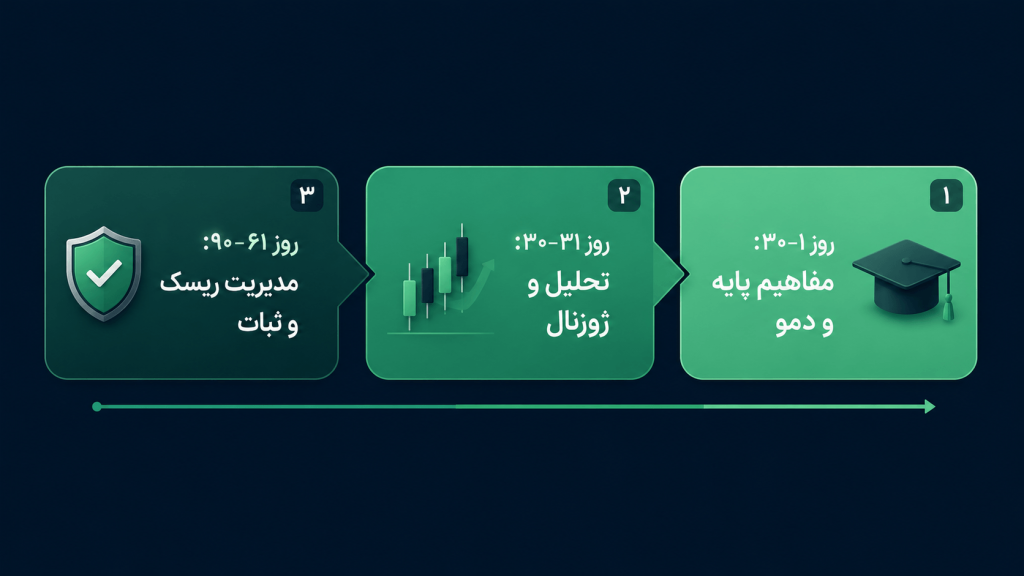
A Suggested 90-Day Plan for Starting From Zero
| Period | Main focus | Expected outcome |
|---|---|---|
| Days 1–30 | Core concepts and terminology, working with MetaTrader and TradingView, opening a demo account | Full command of the platform and correct order execution with stop loss and take profit |
| Days 31–60 | Technical analysis (candles, support/resistance, trend), the economic calendar, starting a journal | One simple written strategy and at least 30 logged demo trades |
| Days 61–90 | Risk management and psychology, refining the strategy based on your journal | Relative consistency on demo and an informed decision about going live with a small account |
Reliable Resources for Continuing
- BabyPips School — the best-known free forex course in the world
- Investopedia — a solid reference for financial and investment concepts
- BIS Triennial Survey — official data on the size and structure of the global FX market
- TradingView — the best charting tool available, with a global trader community
- Books: Trading in the Zone by Mark Douglas; Technical Analysis of the Financial Markets by John Murphy
Frequently Asked Questions
How long does it take to learn forex?
Learning the core concepts usually takes two to three months. Reaching consistency and sustained profitability takes most people between one and three years of continuous practice. Be sceptical of anyone promising a shorter timeline.
How much capital do you need to start?
Technically you can start with a few dozen dollars on a cent account. A sensible figure for a standard account where real risk management is actually workable usually starts somewhere between $200 and $500. More important than the amount is the principle: only trade with money you can afford to lose.
Can you learn forex for free?
Yes. The combination of the educational articles on this site, the free BabyPips course and practice on a demo account is entirely sufficient to reach an intermediate level. Paid courses are only worth it when the instructor is well known and the syllabus is transparent.
Is forex trading possible for Iranians?
Yes, through international brokers that accept Iranian clients, with deposits and withdrawals typically handled in rial or via USDT. Brokers holding top-tier US and European regulation do not serve Iranian residents because of sanctions, which makes checking a broker's credibility and track record doubly important.
Forex or crypto — which is better?
Neither is better in absolute terms. Forex offers higher liquidity, tighter spreads and more technically well-behaved price action; crypto offers sharper volatility and a market open seven days a week. Many Iranian traders use both. The principles of analysis and risk management are identical in each, so learning forex effectively prepares you for crypto as well.
Is forex gambling?
Trading without knowledge, without a stop loss and with your entire capital — yes, that is precisely gambling. But trading with a written strategy, disciplined risk management and a recorded track record is a professional activity built on probabilities, much like what large investment funds do every day.
How does a demo account differ from a live account?
Prices and tools are identical. The real difference is virtual money and, as a result, the absence of psychological pressure. Demo is excellent for learning the platform and testing strategies, but the skill of controlling your emotions is only built on a live account. That is why the recommendation is to move to live with a small sum after your demo period.
What is the best time to trade?
The London–New York overlap — roughly 16:30 to 20:30 Tehran time, or 13:00 to 17:00 UTC — is the most volatile and liquid window of the day, and the best period for most strategies.
Conclusion: What Is Your Next Step?
This guide has covered the full path into the forex market: understanding the market's structure and terminology, choosing a broker suited to Iranian traders, technical and fundamental analysis, risk management and trading psychology. If we had to compress all of it into three sentences:
- Forex is a profession, not a lottery ticket. Treat it the way you would treat learning a new trade.
- Your survival in the market depends on risk management, not on being right about direction.
- No amount of reading substitutes for practice. Real learning happens on the chart.
Your next practical step is simple: open a free demo account, pull up your first chart, and work through what you have read here one piece at a time. The market is not going anywhere. Your impatience is the only thing that can hurt you.