


- August 11, 2026
- Posted by: Reza Kazemi
- Category: Forex Education
Disclosure: forexirantrading.com is an affiliate site and a partner of the broker Investizo. If you open an account through links on this page, we may receive a commission at no extra cost to you. Please keep this in mind when reading this comparison.
For an Iranian trader, choosing a broker is the most consequential decision to make before placing a single trade — more consequential, in fact, than choosing a strategy. The reasoning is simple: the finest analysis in the world is worth nothing if you cannot withdraw your profit. On top of that, sanctions mean many of the large global brokers will not serve Iranian residents, so we are choosing from a narrower field — which makes care in that choice several times more important.
This guide starts with the criteria that genuinely matter from an Iranian user’s perspective, then reviews the best-known brokers accepting Iranian clients along with their drawbacks, and closes with a practical checklist to run before you deposit your first dollar. If you are not yet familiar with the basics of the market, we suggest reading our complete forex guide for beginners first and then coming back to this article.
⚠️ Disclaimer: this article is for information and education only and is not investment advice. Forex trading carries substantial risk, and responsibility for choosing a broker and managing your capital rests entirely with you. Broker terms — fees, minimum deposits, payment methods — change regularly; always verify the current details on the broker’s official website.
Why Broker Selection Works Differently for Iranians
A European trader can visit their national regulator’s website, look up the list of licensed brokers and choose with confidence. For us the situation is different:
- Banking sanctions: brokers holding tier-one regulation — those supervised in the US (NFA/CFTC), the UK (FCA) or Australia (ASIC), including major names such as Interactive Brokers and OANDA — do not serve clients resident in Iran.
- Offshore regulation: brokers that do accept Iranian clients generally operate under offshore authorities — Seychelles, St. Vincent, Belize, the Comoros and others. These regimes do not impose the rigour of European supervision, which means the weight of trust falls on the broker’s actual record of paying Iranian clients, not on a regulator’s logo.
- The money route: direct bank transfers are not available to Iranians. Funds move through the broker’s partner rial exchanges or via Tether (USDT), and the quality of that route is in practice one of the most important selection criteria.
- Policy risk: brokers can restrict or stop accepting Iranian clients as conditions change. For that reason, never keep your entire capital with one broker, and withdraw profits on a regular schedule.
Seven Criteria for Choosing a Broker as an Iranian Trader
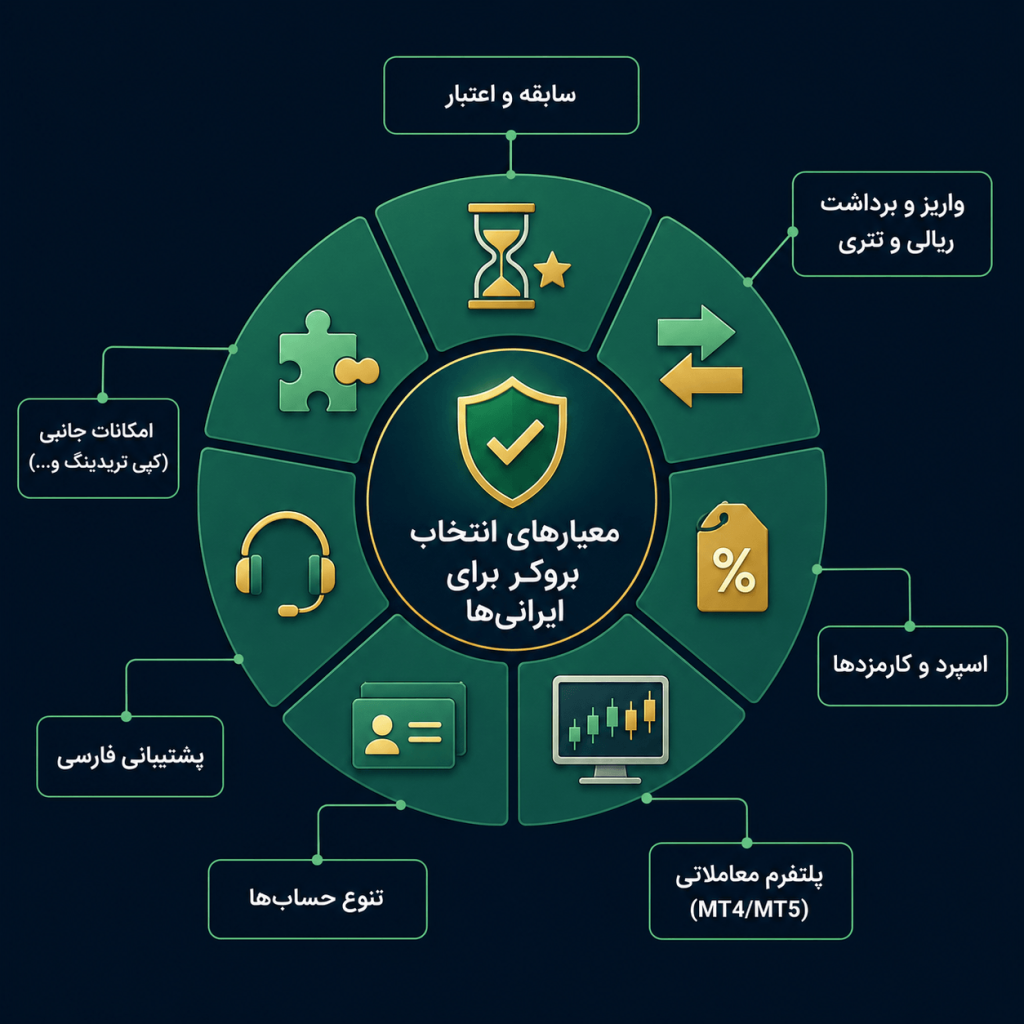
- 1. Track record and credibility. How long the broker has operated, its history of paying Iranian users without incident, and genuine trader feedback — not promotions from signal channels. A broker with fifteen years of consistent payouts is more trustworthy than a recent arrival with glossy promises.
- 2. Deposit and withdrawal route. Support for rial and USDT, settlement speed, fees and minimum withdrawal amounts. A withdrawal that takes several days or carries a heavy fee eats into your returns over time.
- 3. Trading costs. Spreads on the major pairs and on gold — the most popular instrument among Iranian traders — commission on ECN accounts, and swap rates. Measure these yourself on a demo or small live account.
- 4. Trading platform. MetaTrader 4 and 5 support is the minimum standard; the ability to trade through TradingView or cTrader is a serious advantage. Watch execution quality and slippage around news releases.
- 5. Range of account types. A cent or micro account for starting small, an Islamic (swap-free) account for Muslim traders, and ECN accounts for more experienced ones.
- 6. Persian-language support. Fast, round-the-clock support in Persian proves its worth precisely when a deposit or withdrawal goes wrong.
- 7. Additional features. Copy trading, PAMM accounts, economic calendar, education and analysis tools.
Quick Comparison of Brokers Popular Among Iranians (2026)
| Broker | Founded | Platforms | Rial deposit / withdrawal | Islamic account | Main strength |
|---|---|---|---|---|---|
| Investizo | 2019 | MT4, MT5, proprietary web platform | Yes (TopChange and Zipay gateways) | Yes (swap-free on both accounts) | $10 minimum deposit, fee-free deposits and withdrawals, copy trading |
| Alpari | 1998 | MT4, MT5 | Yes | Yes | The oldest and best-known name among Iranian traders |
| LiteFinance | 2005 | MT4, MT5, proprietary platform | Yes | Yes | Strong copy trading and a smooth web platform |
| AMarkets | 2007 | MT4, MT5 | Yes | Yes | Active Persian support and services aimed at Iranian users |
| RoboForex | 2009 | MT4, MT5, R StocksTrader | No; according to its official site the broker does not operate in Iran | Yes | Wide range of account types and instruments |
| FIBO Group | 1998 | MT4, MT5, cTrader | Yes | Yes | Two decades of history and ECN accounts |
| Errante | 2018 | MT4, MT5, TradingView, cTrader | No (no rial gateway listed) | Yes | Direct trading inside TradingView |
Exact terms — minimum deposit, live spreads, withdrawal fees — change regularly; check the broker’s official website before opening an account. The order of this table is not an absolute ranking: the best broker for any given trader depends on their style and their own priorities.
Sources for the table (checked on 9 October 2026): Investizo account types, Investizo deposit and withdrawal methods, Errante account types, Errante deposits and withdrawals and the official RoboForex site. For the other brokers, check the details against each broker’s official website.
Brokers Popular Among Iranian Traders
Below are the best-known brokers accepting Iranian clients in 2026. To be clear: “popular” does not mean “flawless” — the drawbacks of each are stated honestly.
1. Investizo
Investizo has operated since 2019 and, according to the company, was founded by a team with a decade of experience in financial markets. What makes it attractive to Iranian traders — particularly newer ones — is the combination of a very low entry threshold and a payment route suited to Iran: the minimum deposit on both account types is just $10, and deposits and withdrawals run both through rial gateways (TopChange and Zipay) and via Tether (TRC20, ERC20, BEP20) and other cryptocurrencies, with no fee charged by the broker. Withdrawal requests are processed within two business days according to the broker.
On platforms, alongside MetaTrader 4 and 5, Investizo offers a proprietary web platform with more than 80 indicators, 50 drawing tools and a built-in economic calendar — a convenient option for trading without installing software. There are two main account types: ECN, with floating spreads from 0.1 pips plus commission, and Standard, commission-free with spreads from 1.5 pips. The broker’s in-house copy trading service is active, and in 2026 it received the Best Social Trading Platform Asia award from Brands Review. The website has a Persian version. According to the broker’s account types page, maximum leverage is 1:1000 and the swap-free option is enabled on both accounts; leverage of 1:2000 is available only under a special broker promotion and its conditions, including a cap on account equity. Ask support for the exact swap-free terms before opening an account.
- Strengths: $10 minimum deposit, suited to starting with modest capital; rial and USDT deposits and withdrawals with no broker-side fee; a proprietary web platform alongside MT4/MT5; copy trading; free VPS for active traders; Persian-language website.
- Drawbacks: company registration in St. Vincent and the Grenadines — a corporate registration rather than strict financial supervision; a shorter history than the two-decade names on this list. And leverage up to 1:2000 is more hazard than opportunity for a beginner — start low.
2. Alpari
Founded in 1998, Alpari is one of the oldest names in the industry and probably the most widely recognised broker among Iranians — a great many experienced Iranian traders opened their very first account here. Alpari has offered dedicated services to Persian-speaking clients for years: a Persian website, Persian support and rial deposit and withdrawal routes.
- Strengths: long history, well-established brand, wide account range from cent to ECN, Islamic account, rial and USDT payments, Persian support.
- Drawbacks: offshore regulation, as with virtually every broker accepting Iranians; spreads on some standard accounts run wider than competitors’.
3. LiteFinance
LiteFinance, formerly LiteForex, has operated since 2005 and has become one of the more popular options among Iranians in recent years — largely thanks to a smooth web platform and an in-house copy trading service that appeals strongly to beginners.
- Strengths: strong copy trading, a modern proprietary platform alongside MT4 and MT5, Persian support, payment routes suited to Iranian users, Islamic account.
- Drawbacks: the entity accepting Iranian clients is offshore-regulated. And in copy trading, picking the wrong trader can turn unprofitable very quickly — take that risk seriously.
4. AMarkets
AMarkets has been active since 2007 and has placed particular emphasis on the Persian-speaking market in recent years: active Persian support, Persian-language webinars and educational content, and payment routes appropriate for Iranian users.
- Strengths: strong Persian-language service and support, rial and USDT payments, Islamic account, and — according to user feedback — reasonable withdrawal processing speed.
- Drawbacks: offshore regulation; a narrower range of tradable instruments than some competitors.
5. RoboForex
RoboForex has operated since 2009 and appeals to traders looking for variety in accounts and instruments — from classic and ECN accounts through to the proprietary R StocksTrader platform for equities.
Important: in the risk warning on its official site, RoboForex lists Iran among the countries where it does not operate (checked on 9 October 2026). Before doing anything, ask the broker directly whether you can open an account and how deposits and withdrawals would work.
- Strengths: a wide range of account types and assets, a cent account for starting small, copy trading programmes.
- Drawbacks: offshore regulation (Belize). According to its official site, the broker does not operate in Iran.
6. FIBO Group
FIBO Group is the same age as Alpari, founded in 1998, and is better known among more experienced traders — particularly for its ECN accounts and cTrader support alongside MetaTrader.
- Strengths: over two decades of history, ECN accounts with tight spreads, cTrader support, Islamic account.
- Drawbacks: the environment and account structure are somewhat more complex for a beginner than at competitors.
7. Errante
Errante is a younger broker — founded in 2018, headquartered in Cyprus, regulated by the Seychelles FSA for international clients — that became known among Iranians for one distinctive feature: the ability to trade directly inside TradingView, alongside support for MetaTrader 4 and 5 and cTrader.
- Strengths: an unusually broad platform range (TradingView, cTrader, MT4/MT5), ECN execution, Islamic account.
- Drawbacks: a shorter history than the older brokers on this list. Errante’s deposit and withdrawal page lists no rial gateway. To be safe, start with a small amount and test the withdrawal route.
Deposits and Withdrawals for Iranians: How the Money Route Works
The most common ways of moving money between an Iranian bank account and a trading account:
| Method | Typical speed | Points to watch |
|---|---|---|
| Rial deposit/withdrawal via the broker’s partner exchange | Minutes to a few hours | The most convenient route. Always compare the exchange’s conversion rate against the market rate |
| Tether (USDT) | Minutes | Network fees are low, TRC20 preferably. Enter the wallet address with care |
| Other cryptocurrencies | Depends on the network | Price movement in the coin during transfer adds risk. A stablecoin is safer |
The true cost of each route is not only the stated fee — the exchange’s buy-sell spread is part of your cost too. For the full picture, read our guide to USDT and rial deposits and withdrawals at forex brokers.
The Golden Checklist Before Funding a Live Account
- 1. Test with a small amount. Before any serious deposit, make a small one, place a few trades and take one real withdrawal. Until you have seen the full deposit–trade–withdraw cycle, do not entrust significant capital to any broker.
- 2. Complete verification at the outset. Do not let your first encounter with the verification process be the moment you want to withdraw profit.
- 3. Log in from the official address. Phishing sites imitating brokers are common. Type the address directly and do not open promotional links from Telegram.
- 4. Measure spreads and execution on a demo account, particularly on gold and the major pairs at different hours.
- 5. Read the Islamic account terms. Some brokers charge a substitute fee in place of the swap. Check the details before choosing.
- 6. Split your capital. Do not keep everything with one broker, and withdraw profits regularly.
To test spreads and execution without risk first, see our guide to free forex demo accounts.
Warning: Stay Away From These Traps
- Unknown brokers with extravagant bonuses. A 100% bonus from a broker whose website is six months old is bait, not a gift.
- Promises of guaranteed profit. No broker, no fund and no “mentor” can guarantee returns. Frame that sentence.
- Opaque managed accounts. Handing your trading account password to someone else is the single most common route to total capital loss among Iranian traders.
- Blind signal copying. If you use copy trading, examine the trader’s multi-month record, their maximum drawdown and the logic of their trades — not just last month’s percentage gain.
Frequently Asked Questions
Which is the best forex broker for Iranians?
There is no absolute answer; “best” depends on your priorities. For starting with modest capital and fee-free rial and USDT transfers, Investizo is an appealing option with its $10 minimum deposit. If track record and brand matter most to you, Alpari and FIBO Group are the oldest. For copy trading, Investizo and LiteFinance are well known. For trading inside TradingView, Errante stands apart. And for active Persian-language support, AMarkets has a strong following. Use the seven criteria in this article to match the choice to your own circumstances.
Do brokers regulated in Europe or the US accept Iranian clients?
No. Because of sanctions, brokers supervised by bodies such as the UK’s FCA, the US NFA or Australia’s ASIC do not accept clients resident in Iran. Brokers that do accept Iranians operate under offshore regulation, which is exactly why examining their payment record matters twice as much.
How can I tell whether a broker is fraudulent?
Warning signs: a short operating history, promises of guaranteed profit, implausible bonuses, no transparent withdrawal route, unusual obstruction at withdrawal time, and a lack of clear information about the company and its regulation. And the most practical test of all: a small deposit followed by a real withdrawal, before you extend full trust.
Is depositing and withdrawing with USDT safe?
Yes, provided you observe the technical basics: use the correct network — usually TRC20 for its low fees — copy the wallet address exactly, and start with a small amount to test the route. Because its price is stable, Tether carries less exposure to price movement during transfer than other cryptocurrencies.
How much should I open a live account with?
After a demo period, starting with a cent account or a modest sum — $50 to $200, say — is sensible: not so little that it feels irrelevant, and not so much that losing it would hurt. We cover the details in our complete forex guide for beginners.
Which brokers offer Islamic accounts?
Every broker on this list has a swap-free option. At Investizo, the account types page shows Swap Free enabled on both the ECN and Standard accounts, and Errante offers it on all accounts on request. Alpari, LiteFinance, AMarkets, FIBO Group and RoboForex also offer Islamic accounts (RoboForex, according to its own site, does not operate in Iran). What differs is the arrangement replacing the swap, such as a holding fee after a number of days; ask each broker’s support for the details before opening an account.
Conclusion
For an Iranian trader, choosing a broker is a risk management decision rather than a matter of taste. Our suggested formula is straightforward: choose from established, well-known brokers; test the deposit and withdrawal route with a small amount; do not concentrate your capital with one broker; and withdraw profits on a regular schedule. And before any of that, make sure you actually know how to trade — no broker can substitute for your own knowledge and risk management.
The practical step: open a free demo account, assess the platform and spreads without risk, and when you are ready, enter a live account with a small amount.