


- August 11, 2026
- Posted by: Reza Kazemi
- Category: Forex Education
You can be the finest analyst in the market, but if you do not know how your money reaches a trading account and — more importantly — how it comes back intact, you are not ready to trade. For an Iranian trader, cut off from international cards and direct bank transfers by sanctions, “the money route” is a separate skill that has to be learned the same way technical analysis is learned.
This guide opens up both main routes in full: rial deposits and withdrawals through the broker’s partner gateways, and Tether (USDT) with the right network selected. It also covers the hidden costs of each route, the security essentials, and fixes for the common problems — the things people usually learn after their first bad experience, which you are going to know beforehand.
Why the Money Route Is Different for Iranians
In most countries, funding a trading account means entering a bank card number or making a simple transfer. For an Iranian user that route is closed, because the country’s banking network is disconnected from international payment systems. Brokers accepting Iranian clients have solved the problem two ways:
- Rial gateways: exchanges and payment services partnered with the broker that take your rial and credit the dollar equivalent to your trading account — and the reverse on withdrawal.
- Cryptocurrency: chiefly Tether (USDT), which because of its price stability has become the unofficial standard for moving funds among Iranian traders.
Comparing the Methods
| Method | Typical speed | Main cost | Who it suits |
|---|---|---|---|
| Broker’s partner rial gateway | Minutes to a few hours | The exchange’s conversion margin, plus any gateway fee | The simplest route — anyone who would rather not deal with crypto |
| Tether (USDT) | Minutes, after network confirmation | Network fee, plus the buy/sell spread on Tether at the local exchange | Full control over the route — users comfortable with wallets |
| Other cryptocurrencies (Bitcoin and so on) | Depends on the network | Network fee, plus exposure to the coin’s price movement in transit | Only when USDT is unavailable. Not recommended for beginners |
Our general recommendation: start with your broker’s rial gateway, which is simpler and less error-prone, and learn to work with USDT over time. Having both routes available means your money never gets stuck behind a single closed door.
Rial Deposits and Withdrawals, Step by Step
Brokers active in the Iranian market usually offer one or more rial gateways in the client area — Investizo, for instance, supports the TopChange and ZP gateways, while Alpari, AMarkets and LiteFinance each have their own rial routes. The steps are almost identical everywhere:
- Step 1: open the Deposit section of your broker’s client area and select the rial gateway.
- Step 2: enter the amount. The system shows the rial-to-dollar conversion rate and the final figure. Stop here and compare that rate against the live market rate — the gap between the two is your real, hidden cost.
- Step 3: complete the payment through the gateway. The dollar amount usually appears in your trading account within minutes to a few hours.
- Withdrawal: the same route in reverse — request a withdrawal to the same gateway and receive rial to your own bank card. Under anti-money-laundering rules, withdrawals are only possible to an account in your own name. Put any thought of using a relative’s card aside now.
Depositing and Withdrawing With Tether (USDT)
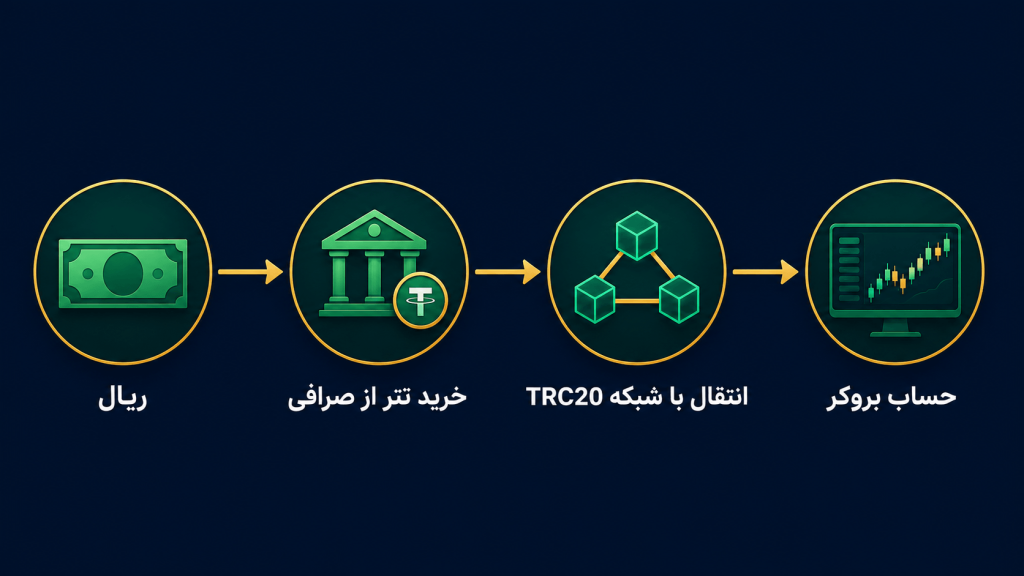
The Tether route has three stations: the local crypto exchange, where you buy Tether with rial; the blockchain network, which moves it; and the broker’s account. Withdrawal is exactly the same route in reverse.
Choosing the Network: The Most Important Technical Decision
Tether moves across several different networks, and the network you send on must match exactly the one the broker specified. Sending on the wrong network is the most common way money goes missing on this route:
| Network | Transfer fee | Speed | Notes |
|---|---|---|---|
| TRC20 (Tron) | Very low — usually around 1 USDT or less | Seconds to a few minutes | The default choice for Iranian traders |
| BEP20 (BNB Smart Chain) | Low | Fast | A good option when both ends support it |
| ERC20 (Ethereum) | High and variable | Variable | Not economical for small amounts |
USDT Deposit, Step by Step
- Step 1: buy Tether from a reputable local exchange. Criteria for choosing one: how long it has operated, its licences, trading volume, and a reasonable gap between its buy and sell rates.
- Step 2: in the broker’s client area, select deposit by USDT and specify the network — TRC20 preferably. The broker gives you a wallet address.
- Step 3: copy that address — never type it by hand — and, at the exchange, submit a Tether withdrawal to that address on that same network.
- Step 4: after a few network confirmations the amount lands in your broker account. Most brokers credit the dollar equivalent automatically.
- The golden rule: make your first transfer to any new address a small test amount. Once it arrives successfully, send the rest. A few minutes of patience is insurance on your entire capital.
The Real Costs: Look Beyond the Stated Fee
The cost of a full deposit-and-withdrawal cycle is the sum of several items, only one of which is visible:
- The rate gap (exchange spread): the difference between the Tether buy/sell price, or the gateway’s conversion rate, and the true market rate. Usually the largest cost item and the least visible.
- Network fee: on crypto transfers. Negligible on TRC20.
- Broker fee: many brokers, Investizo among them, charge nothing for deposits and withdrawals — but verify this for your own broker.
- Minimum withdrawal: if your account is small, know the broker’s and the exchange’s minimums in advance, so your money does not get stranded below the threshold.
A professional’s trick: run one complete round trip with a fixed amount — $50, say — and calculate the percentage difference between what you started with and what came back. That number is your route’s real cost, and it is the best basis for comparing brokers and exchanges.
Security: Where One Mistake Costs Everything
- Phishing, risk number one: always type your broker’s and exchange’s address directly, or open them from your own bookmarks. Counterfeit sites differing by a single character in the domain are built precisely to catch the moment of deposit.
- Two-factor authentication: enable it on your exchange, broker and email accounts — preferably with an app such as Google Authenticator rather than SMS.
- Check the wallet address twice: compare the first and last few characters of the destination before final confirmation. Clipboard-hijacking malware that swaps addresses is real, and it claims victims.
- Do not park money in transit: an exchange or an intermediate wallet is not a place to store capital. Bought Tether? Transfer it. Withdrew profit? Move it to rial or a secure personal wallet.
- Financial privacy: do not post account details, amounts or withdrawal screenshots in groups or on social media. Social engineering starts with exactly that information.
Common Problems and Their Fixes
| Problem | Usual cause | What to do |
|---|---|---|
| USDT deposit has not arrived | Wrong network, or network congestion | Get the transaction hash (TXID) from the exchange and check it in the network explorer. If the network was wrong, contact broker support immediately — in some cases it is recoverable |
| Rial withdrawal is stuck | Incomplete verification, or a queue at the gateway | Complete your documents in advance; chase the status with the broker’s support and the gateway simultaneously |
| Broker rejected the withdrawal | Name mismatch, bonus terms, or withdrawing to a different destination than the deposit came from | Read the broker’s withdrawal rules before depositing. Most brokers only permit withdrawal by the same method and to the same destination as the deposit |
| Unfair conversion rate | A wide spread at the gateway or exchange | Compare the rate against the live market rate before confirming. If the gap is large, try the USDT route or a different gateway |
| Money “lost” between exchange and broker | Usually not lost — it is queued for network confirmation | Check the status in the explorer using the TXID. Wait for full confirmation and do not send again |
Final Checklist Before Your First Deposit
- Verification is complete at both the broker and the local exchange
- I have read the broker’s withdrawal methods, minimums and fees
- Two-factor authentication is enabled everywhere
- I have tested the route with a small amount — both deposit and withdrawal
- I have selected the same Tether network (TRC20) at both the sending and receiving end
- I have compared the conversion rate against the market rate
- I am only using money I can afford to lose
Frequently Asked Questions
Is a rial deposit better, or USDT?
For a beginner, the rial gateway is simpler and less error-prone. The USDT route in exchange offers more control and transparency, and leaves you less dependent on any one broker or gateway. Experienced traders generally know both and choose according to conditions — rates and speed.
How long does withdrawing profit take?
Processing on the broker’s side is usually a few hours to two business days — Investizo, for example, states a maximum of two business days. After that, the money’s arrival depends on the route: gateway settlement in rial, or blockchain confirmation, taking anywhere from minutes to a few hours. A first withdrawal may be slower because of verification checks.
Which Tether network is best for depositing to a broker?
In most cases TRC20 — very low fees, high speed, and support from virtually every local exchange and broker. Just do not forget the core rule: the network selected at the sending and receiving ends must match.
If I send Tether on the wrong network, is the money gone?
Not necessarily, but the situation is serious. Retrieve the transaction hash immediately and contact support at the destination — broker or exchange. In many cases, where the address on the other network is also under the same organisation’s control, the amount is recovered through manual review, sometimes with a fee. There is no guarantee, though. The reliable approach remains the small test transfer.
Are there legal restrictions on depositing to a broker?
Forex trading is not regulated by domestic authorities in Iran, and responsibility for the activity and for moving funds rests with the user. The general advice: use transparent routes in your own name, keep records of your transactions, and avoid buying or selling Tether “by hand” with strangers — that carries both fraud risk and the risk of tainted funds.
Conclusion
The money route for an Iranian trader has two main lines — the rial gateway and Tether — and command of both means complete freedom of movement. Observe the three rules from this article at all times: compare the conversion rate against the market, check the network twice, and test every new route with a small amount first. Those three habits alone will carry you past ninety per cent of the trouble beginners run into.
If you have not chosen a broker yet, compare deposit and withdrawal terms first, and before any real deposit, get to know the trading environment with a free demo account.