


- August 11, 2026
- Posted by: Reza Kazemi
- Category: Forex Education
For many Muslim traders, the first question before entering forex is neither which strategy to use nor which broker to choose. It is this: can I trade at all in a way that does not involve interest? The forex industry’s answer to that concern is the Islamic account, also called a swap-free account — an account in which overnight interest on positions is removed.
This article explains it plainly and without promotional gloss: what swap actually is and why it raises a religious objection, how an Islamic account works, what brokers charge instead of swap — the part many articles leave out — which brokers accepting Iranian clients offer it, and how to enable one.
What Is Swap, and Why Does It Raise a Religious Question?
When you hold a forex position overnight, an amount called swap is debited from or credited to your account at the end of the trading day. Its origin is the interest rate differential between the two currencies in your pair. In a forex trade you are effectively borrowing one currency in order to buy another, and interest changes hands on that borrowing. If you have bought a currency with a high interest rate against one with a low rate, you may receive positive swap; in the reverse case, you pay negative swap.
The sensitivity lies exactly there: swap is interest by nature, and receiving or paying interest is considered a form of riba — usury — which is forbidden in Islam. For that reason Muslim traders on standard accounts face a religious difficulty even when their trades are profitable, and the industry designed the Islamic account for precisely this group.
What Is an Islamic Account and How Does It Work?
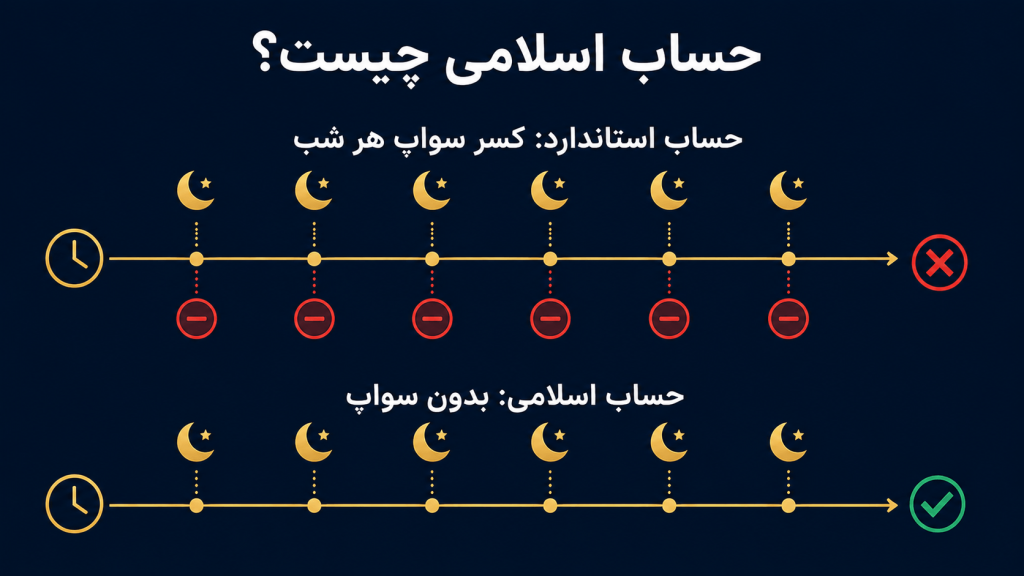
Technically, an Islamic account is an ordinary trading account — same platform, same instruments, same base spread — with one key difference: overnight swap is zero. You can hold a position for days or weeks without any interest changing hands. These accounts are sometimes labelled Swap-Free or Shariah Account, and at most brokers everything else — leverage, minimum deposit, available instruments — matches the equivalent standard account.
Islamic Account Versus Standard Account
| Feature | Standard account | Islamic (swap-free) account |
|---|---|---|
| Overnight swap | Charged or credited | None |
| Base spread and commission | According to account type | Usually identical to the equivalent account |
| Cost of holding long term | Daily swap | At some brokers, a fixed fee after a number of days |
| Positive swap (interest income) | Possible on some pairs | Removed — both payment and receipt |
| Carry trade strategy (profiting from rate differentials) | Possible | Meaningless |
| Platform, instruments and leverage | Identical at most brokers | |
Something You Should Know: The Broker Does Not Lose Money
Let us be straightforward: a broker is a business, and it does not give swap away as a gift — it recovers it elsewhere. Three common methods:
- Administration fee: the most common approach. A position genuinely stays cost-free for a set number of days — 3 to 14, depending on the broker and instrument — after which a fixed daily fee in dollars is charged in place of swap.
- A slightly wider spread: some brokers set marginally wider spreads on certain instruments in the Islamic version.
- Restricted instruments: some brokers limit particular instruments — usually exotic pairs with large interest differentials — on Islamic accounts, to prevent the arrangement being exploited.
Before opening an account, ask the broker’s support these three questions: how many days does the swap exemption last? What is the substitute fee after that, and on which instruments? And does the Islamic account’s spread differ from the equivalent standard account? Get the answers in writing and keep them.
For a short-term trader who closes positions the same day or within two or three days, these costs never actually activate. For a long-term trader, comparing the numbers carefully is essential.
Which Brokers Offer Islamic Accounts to Iranian Clients?
Nearly every well-known broker accepting Iranian clients offers an Islamic account, given the religious composition of their client base — Alpari, LiteFinance, AMarkets, RoboForex, FIBO Group and Errante among them. The exact terms, particularly the number of exempt days and the substitute fee, differ between them.
How to Enable an Islamic Account
- Step 1: register with your chosen broker and complete identity verification.
- Step 2: when creating the trading account, if a “Swap-Free” or “Islamic account” option is offered, select it there.
- Step 3: if no such option appears in the form, request conversion to swap-free through the client area or support chat. Some brokers will convert an existing account.
- Step 4: before your first live trade, verify the instrument’s swap status in MetaTrader: right-click the symbol in Market Watch → Specification → both Swap Long and Swap Short should read zero.
An Important Religious Point: The Islamic Account Is Not the Whole Question
To be honest about this: removing swap addresses only one of the religious considerations around forex trading. On the permissibility of forex trading itself, on leverage, and on instruments such as CFDs, scholars and religious authorities hold differing views, and this article is not in a position to issue a religious ruling.
If observing religious principles matters to you — and the fact that you are reading this article suggests it does — our recommendation is that alongside choosing a swap-free account, you seek a ruling on forex trading from the office of your own marja, so that you can proceed with a clear conscience.
Who Is an Islamic Account Suitable For?
- The natural choice for: Muslim traders who want to stay clear of any suspicion of riba; and medium-term traders who hold positions for several days and were paying heavy negative swap on a standard account.
- A note for scalpers and day traders: if all your positions close the same day, swap never reaches you and the practical difference between the two accounts is essentially zero. In that case choosing an Islamic account is purely a matter of religious reassurance, and it costs you nothing extra — provided the spread is the same.
- Who should look more carefully: long-term traders holding positions for weeks. The administration fee after the exemption period can exceed ordinary swap. Compare the numbers before you commit.
Frequently Asked Questions
Is an Islamic account genuinely interest-free?
Yes — on an Islamic account, overnight swap, which is interest in nature, is neither paid nor received. However, some brokers charge a fixed administration fee after a position has been held for a number of days, which they present as a service charge. Ask your broker for the details, and if this matters to you religiously, put the question to your own marja.
Is an Islamic account more expensive than a standard one?
For short-term trading there is usually no difference at all. For long-term positions, depending on the broker, the administration fee after the exemption period may be lower or higher than typical swap — which is why comparing the actual numbers before choosing is essential.
Does opening an Islamic account require any special documentation?
At most brokers accepting Iranian clients, no. The Swap-Free option is enabled when creating the account, or with a simple request to support. Some international brokers offer the account only to clients in Muslim-majority countries, which in practice creates no restriction for Iranian users.
Can you trade gold and cryptocurrency on an Islamic account?
At most brokers, yes — gold (XAU/USD) and other CFD instruments are available in the swap-free version. The exemption period or substitute fee may, however, be defined differently for these instruments than for currency pairs.
Does an Islamic account mean forex trading is definitely permissible?
No. An Islamic account removes only the question of swap — overnight interest. On the permissibility of forex trading itself and its instruments, scholarly opinion differs, and for certainty you should seek a ruling from your own marja.
Conclusion
The Islamic account is the forex industry’s solution for removing overnight interest from trading: the same trading account, without swap, and generally on identical terms for short-term trading. Do not lose sight of this article’s key point: before opening one, get a clear answer from your broker about the exemption period and the substitute fee — and for complete religious certainty, put the question to your own marja.
If you would like to experience the trading environment without any risk before deciding, open a free demo account.