

'/%3E%3C/svg%3E)
- August 11, 2026
- Posted by: Reza Kazemi
- Category: Forex Education
Every forex trade, however elaborate, rests on three simple pillars: the pip (the unit that measures price movement), the lot (the unit that measures trade size), and leverage (the multiplier that makes a large position possible on modest capital). Until you can work these three out on your fingers, every trade is a leap in the dark. Get comfortable with them and, before every click, you will know precisely what you are risking.
This article covers all three with real worked examples, reference tables and one complete trading scenario. It expands on the terminology section of the beginner’s guide.
What Is a Pip?
The short answer: a pip is the smallest standard unit of price change in forex. In most currency pairs that means the fourth decimal place. If EUR/USD moves from 1.0850 to 1.0855, price has risen by 5 pips.
Two exceptions worth knowing:
- Japanese yen pairs: because these are quoted to two decimal places, the pip is the second decimal. USD/JPY moving from 155.20 to 155.50 is 30 pips.
- Pipettes: most brokers display one additional decimal — 1.08503, for instance. That fifth digit is a tenth of a pip, known as a pipette. Beginners sometimes mistake pipettes for pips and read every move as ten times larger than it is.
What Is a Pip Worth in Dollars?
Pip value depends on trade size — and this is exactly where pips connect to lots:
| Trade size | Value of one pip on dollar pairs (e.g. EUR/USD) |
|---|---|
| 1 standard lot | Around $10 |
| 0.1 lots (mini) | Around $1 |
| 0.01 lots (micro) | Around $0.10 (10 cents) |
An immediate example: buying EUR/USD at 0.1 lots, a 50-pip move in your favour is roughly $50 in profit. The same move against you is $50 lost. From here on, you can translate any movement on the chart into dollars.
What Is a Lot?
The short answer: a lot is the unit of trade size. One standard lot equals 100,000 units of the base currency. Buying 1 lot of EUR/USD therefore means a position worth €100,000 — even if your account balance is $500. That is where leverage enters the picture.
| Lot type | Shown in MetaTrader as | Size (units of base currency) | Who it suits |
|---|---|---|---|
| Standard | 1.00 | 100,000 | Large, professional accounts |
| Mini | 0.10 | 10,000 | Accounts of a few thousand dollars |
| Micro | 0.01 | 1,000 | Beginners and small accounts — the correct starting point |
| Nano / cent account | — | 100, or the cent equivalent | Practising with very small amounts of real money, at brokers offering cent accounts |
A specific warning about gold: on XAU/USD, one lot means 100 ounces. At that size, every $1 move in the gold price is $100 of profit or loss. A position size that feels ordinary on EUR/USD can be heavy on gold — always check the instrument’s specification in MetaTrader.
What Is Leverage?
The short answer: leverage is the multiplier your broker extends to your capital, allowing you to trade a position larger than your balance. At 1:100 leverage, opening a $10,000 position locks only $100 of your account as margin — collateral.
The relationship is simple: required margin = position value ÷ leverage
| Leverage | Margin required for 0.1 lots of EUR/USD (≈ $10,850) |
|---|---|
| 1:50 | About $217 |
| 1:100 | About $108 |
| 1:500 | About $22 |
| 1:1000 | About $11 |
And now the most important sentence in this article, which contradicts what a great many people have been told: leverage does not, by itself, multiply your profit or loss — position size does. The profit and loss on any trade are calculated purely from size (lots) and price movement (pips). Leverage only determines how much of your money is locked as collateral.
The real danger of high leverage is the temptation it creates. When $100 “allows” you to open 1 lot, plenty of people do exactly that — and then every pip of movement is $10 against a $100 account, which is 10% of your capital. A handful of pips in the wrong direction and the margin call arrives.
How the Three Work Together: A Complete Scenario
You have a $500 account with 1:500 leverage and want to buy EUR/USD at 1.0850. Your analysis puts the stop loss 25 pips below:
- Step 1 — permitted risk: under the 2% rule, $10.
- Step 2 — position size: risk ÷ (stop in pips × pip value at 1 lot) = 10 ÷ (25 × 10) = 0.04 lots.
- Step 3 — margin: the value of a 0.04-lot position is roughly $4,340; divided by 500, that locks about $9. The rest of the account stays free.
- Outcomes: stop is hit → $10 lost, 2% of the account. Price moves 50 pips in your favour → $20 profit, 4% of the account, a 1:2 ratio.
Notice what happened: 1:500 leverage created no danger whatsoever in this scenario, because the formula determined the position size, not the available margin.
Quick Reference Table (Worth Saving)
| Concept | One-line definition | The number to remember |
|---|---|---|
| Pip | The unit of price movement — fourth decimal, or second on yen pairs | At 0.01 lots on a dollar pair, one pip ≈ 10 cents |
| Lot | The unit of trade size | 1 lot = 100,000 units of base currency. Beginners start at 0.01 |
| Leverage | The broker’s credit multiplier — it sets margin, not risk | Margin = position value ÷ leverage |
Common Beginner Mistakes With These Three
- Filling the available margin: “I can, therefore I will.” Position size is determined by risk, not by free margin.
- Confusing pips with pipettes: a factor-of-ten error in both stop placement and position sizing.
- Assuming pip value is universal: a pip on EUR/USD is not a pip on gold or on yen pairs. Check the instrument specification.
- Misplaced fear of high leverage, or misplaced confidence in low leverage: both reveal the same misunderstanding. Risk lives in position size.
- Doing the arithmetic in your head mid-trade: calculate size before you open the platform, on paper or a calculator — not in the excitement of the moment.
Frequently Asked Questions
How many dollars is one pip?
It depends on size. On dollar pairs, one pip is roughly $10 at 1 lot, $1 at 0.1 lots and about 10 cents at 0.01 lots. For non-dollar pairs and metals, check the exact figure in the instrument specification in MetaTrader.
What position size should a beginner start with?
0.01 lots — a micro lot — is the sensible starting point. Each pip risks only about 10 cents, which lets you build genuine experience with real but small money. Always calculate the exact size for each trade with the risk formula rather than using a fixed number.
What is the best leverage for a beginner?
As long as you size positions with the risk formula, the leverage figure is a secondary concern. Moderate leverage — 1:100 to 1:200 — is plenty to start with, and it also reduces the temptation of oversized positions. What matters is never choosing size on the basis of available margin.
Is high leverage forbidden or illegal?
Leverage is a standard credit facility across the forex industry and carries no separate legal status of its own. On the religious permissibility of forex trading and its instruments more broadly, scholarly opinion differs, and it is best to consult your own source of guidance.
How does a margin call relate to these three concepts?
As directly as possible. When position size is large relative to the account, every pip against you consumes a substantial percentage of the balance. Once equity reaches the broker’s threshold, you receive a margin call, followed by automatic closure of positions — the stop-out. Applying the position-sizing formula is, in practice, your insurance against that scenario.
Conclusion
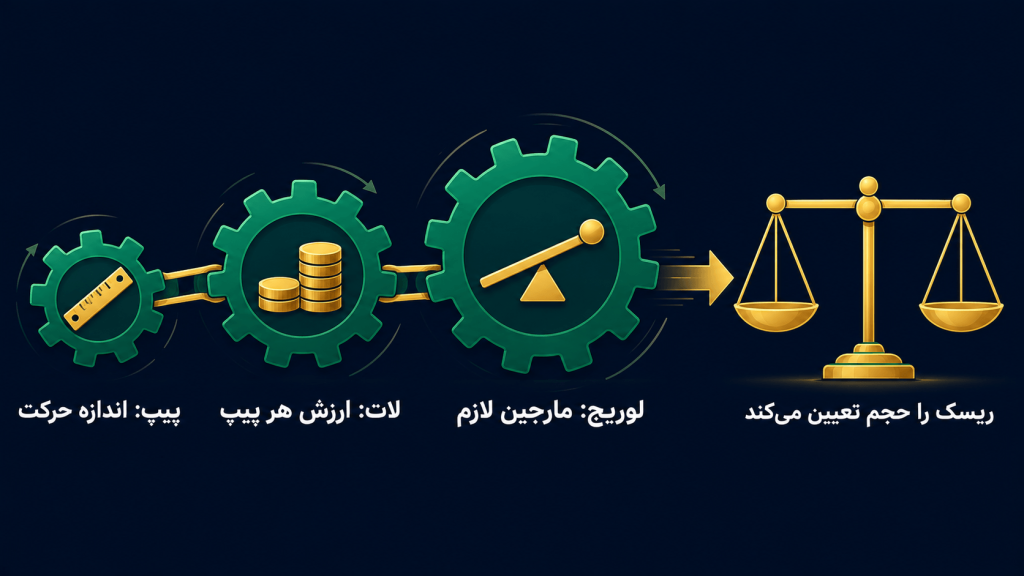
Three concepts, three sentences: the pip measures the movement, the lot determines what each pip is worth in dollars, and leverage only says how much collateral is required. Anyone who understands that chain can work out, in three seconds before any trade, exactly what being wrong will cost — and that is precisely the line between a trader and a gambler.
Today’s exercise: on a demo account, open three trades at 0.01, 0.05 and 0.1 lots and watch the difference in pip value with your own eyes. Ten minutes of practice beats ten readings.